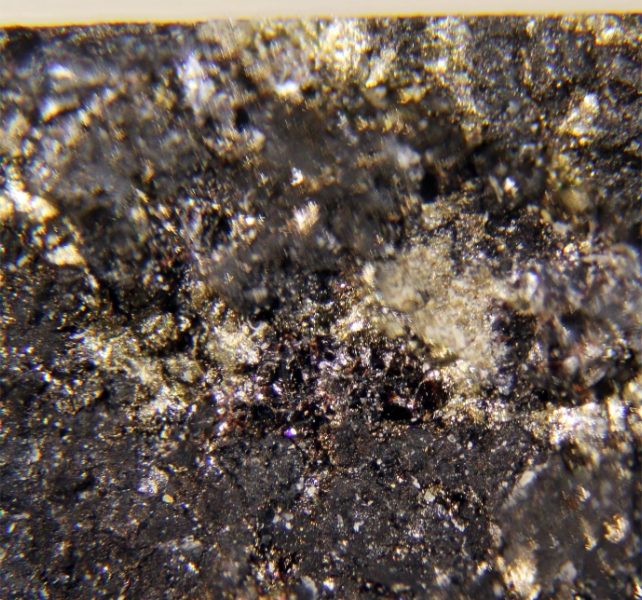
Bronze crystals and crystal aggregates of the FeNi sulphide mineral smythite associated to pyrite from a locality in Montana (Helena Area, Lewis & Clark County, Montana, United States of America). A part of the specimen is polished probably showing that it was analyzed. Ex Vandenbroucke Museum collection specimen, from Waregem, Belgium. — Photo: David Hospital · CC BY-SA 4.0
Smythite
Smythite is an IMA-recognized mineral species in the sulfide class, with the chemical formula (Fe,Ni)₃₊ₓS₄ (x ≈ 0-0.3).
It crystallizes in the hexagonal crystal system (space group R-3m).
Key properties: specific gravity 4.32; Dark gray streak; Metallic; splendent on basal section luster.
IMA symbol Syt, grandfathered status — known before the IMA’s founding, named in 1956.
Formed as a low-temperature oxidation product of the strongly magnetic monoclinic phase of pyrrhotite, as inclusions in calcite crystals in quartz geodes; also in hydrothermal veins.
It is found associated with Pyrite, greigite, mackinawite, pyrrhotite, marcasite, magnetite, sphalerite, galena, chalcopyrite, calcite.
The mineral was named to honor Professor Charles Henry Smyth, Jr. (1866–1937), economic geologist and petrologist, Princeton University, Princeton, New Jersey, USA.