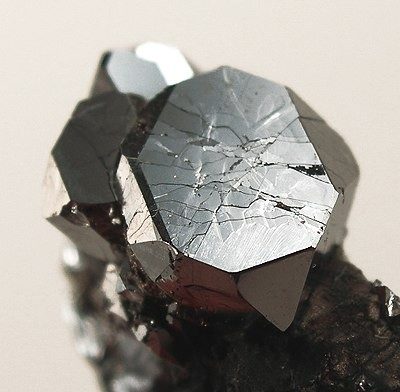
Sperrylite Locality: Talnakh Cu-Ni Deposit, Noril'sk, Putoran Plateau, Taimyr Peninsula , Taymyrskiy Autonomous Okrug, Eastern-Siberian Region, Russia ( Locality at mindat.org ) Size: 2.8 x 1.9 x 0.9 cm. A sharp, very brilliant crystal of 7mm stands out on a cluster of smaller crystals, all displayed dramatically on a natural pedestal of this ore/sulfide matrix. Sperrylite is a rare platinum-containing species that crystallizes in large and beautiful form. This crystal has superb lustre and a brilliant shine to it in person. The main crystal here is remarkable for its symmetry and that all corners are on display. These came out mostly in the early 1990s to the market, though many were said to have been mined in the 1980s and stored in Russia’s strategic reserves until released for sale. — Photo: Robert M. Lavinsky · CC BY-SA 3.0
Sperrylite
Platinum diarsenide — tin-white metallic crystals, a pyrite-structure platinum ore.
Intro adapted from Wikipedia (CC BY-SA).
Sperrylite is an IMA-recognized mineral species in the sulfide class, with the chemical formula PtAs₂.
It crystallizes in the cubic crystal system (space group Pa3). It is a member of the Pyrite structural group.
Key properties: Mohs hardness 6–7; specific gravity 10.58; Black streak; Metallic. R: (400) 53.6, (420) 53.6, (440) 53.9, (460) 53.9, (480) 53.9, (500) 53.9, (520) 54.0, (540) 53.9 luster.
IMA symbol Spy, grandfathered status — known before the IMA’s founding, named in 1889.
The most widespread platinum mineral, found in every type of deposit.
It is found associated with Pyrrhotite, pentlandite, chalcopyrite, violarite, cubanite, bornite, sphalerite, galena, linnaeite, magnetite, testibiopalladite, sudburyite, omeiite, gold.
The mineral was named to honor Francis Lewis Sperry (1861–1906), chemist of Sudbury, Ontario, Canada, who first found the mineral.