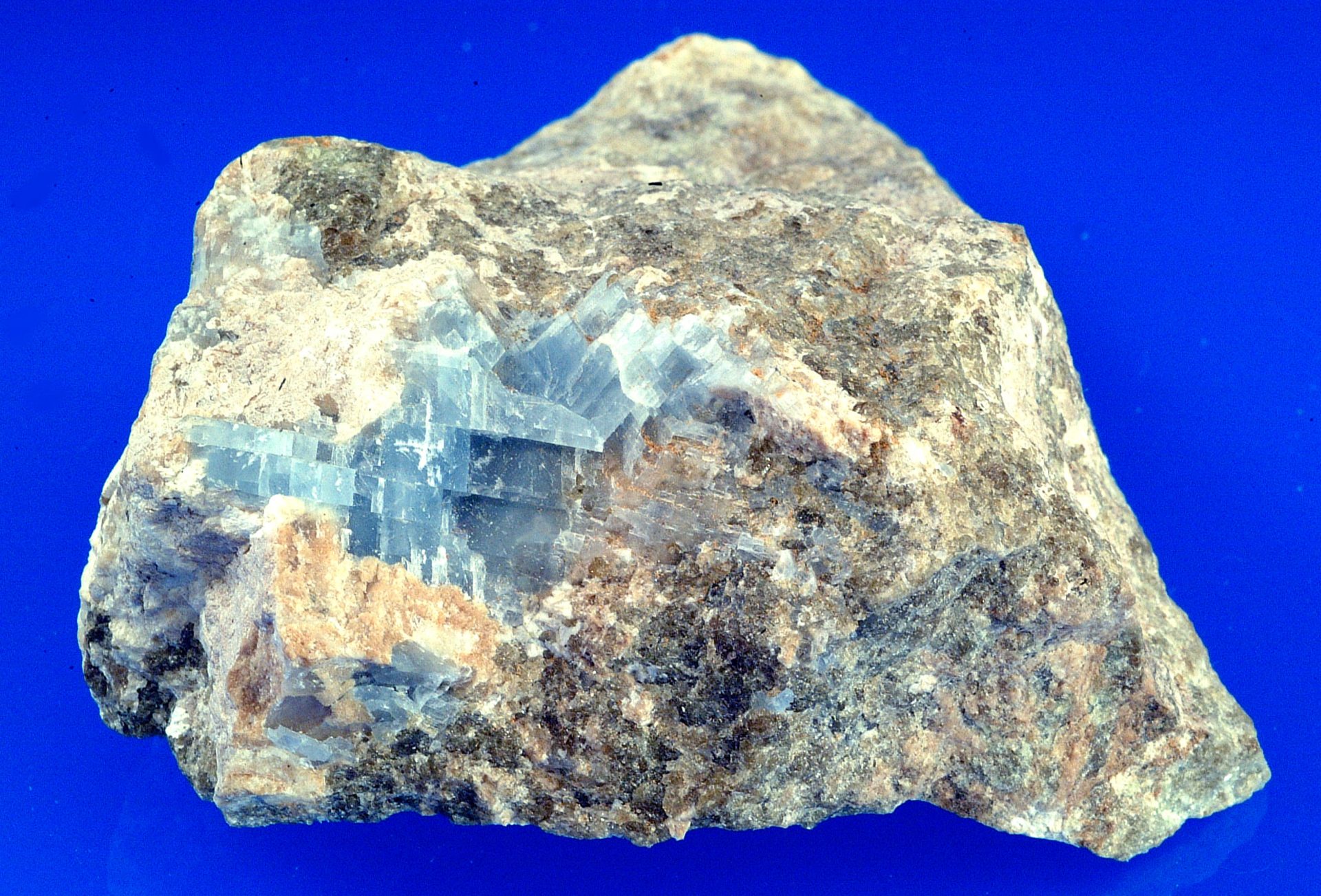
The quarries at Crestmore, California, are famous for blue calcite and for a variety of uncommon calcium silicate minerals. Spurrite, the white-greenish mineral dominating this sample, has composition Ca5(SiO4)2(CO3). It generally occurs in high-temperature contact metamorphic environments such as Crestmore. This specimen is about 9 cm across. — Photo: Darla Sondrol · CC0
Spurrite
A calcium silicate-carbonate of contact-metamorphosed limestones — white to light-blue monoclinic crystals.
Intro adapted from Wikipedia (CC BY-SA).
Spurrite is an IMA-recognized mineral species in the silicate class, with the chemical formula Ca₅(SiO₄)₂(CO₃).
It crystallizes in the monoclinic crystal system (space group P2_1/a). It is a member of the Spurrite-Afwillite structural group.
Key properties: Mohs hardness 5; specific gravity 3.02; Vitreous to resinous luster; refractive index 1.665; optically biaxial.
IMA symbol Spu, grandfathered status — known before the IMA’s founding, named in 1908.
A product of high-temperature thermal metamorphism along the contact between carbonate ro ck and mafic magma.
It is found associated with Gehlenite, merwinite, tilleyite, hillebrandite, scawtite, kilchoanite, rankinite, larnite, foshagite, wollastonite.
The name refers to Josiah Edward Spurr (1870–1950), American geologist.