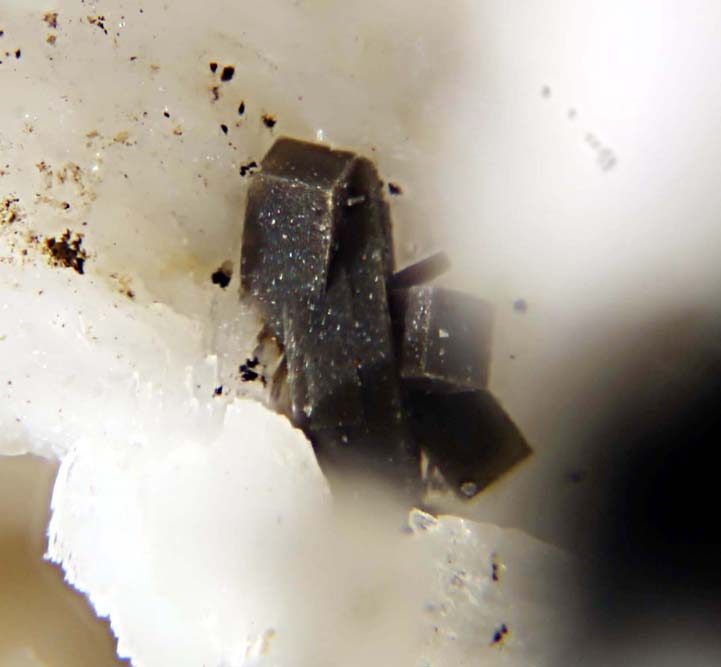
Outstanding tetragonal crystals of the rare mineral steacyite from the type locality (Mont Saint Hilaire, Québec, Canada) and one of the few localities known worldwide. — Photo: David Hospital · CC BY-SA 4.0
Steacyite
A complex thorium-bearing silicate forming small brown cruciform twins, named for Howard Steacy.
Intro adapted from Wikipedia (CC BY-SA).
Steacyite is an IMA-recognized mineral species in the silicate class, with the chemical formula K₀.₃(Na,Ca)₂ThSi₈O₂₀.
It crystallizes in the tetragonal crystal system (space group P4/mcc). It is a member of the Steacyite structural group.
Key properties: Mohs hardness 5; specific gravity 2.95; White streak; Vitreous luster; optically uniaxial.
IMA symbol Scy, IMA status: approved, named in 1981.
Found in cavities in pegmatite veins in nepheline syenite in an intrusive alkalic gabbro-syenite complex (Mont Saint-Hilaire, Canada); in a miarolitic cavity in nepheline syenite (Rouma Isle, Guinea).
It is found associated with Nenadkevichite, analcime, aegirine (Mont Saint-Hilaire, Canada); arfvedsonite, astrophyllite, catapleiite, eudialyte, s¶erandite, villiaumite (Rouma Isle.
The name refers to Harold R. Steacy, formerly Curator of the National Mineral Collection, Geological Survey of Canada, Ottawa, Canada. ¶.