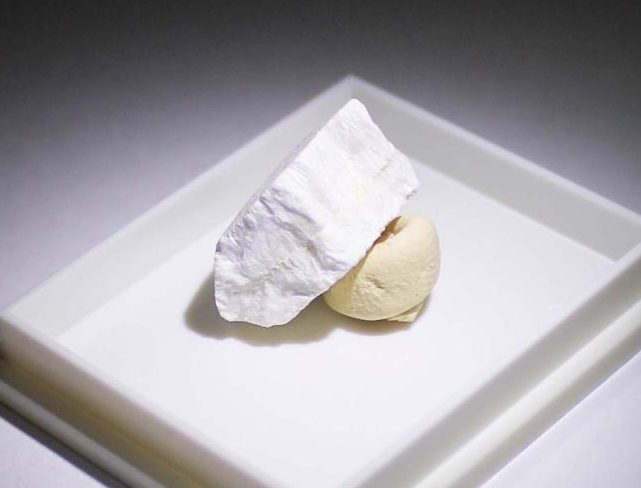
A white specimen of the very rare ammonium sodium phosphate mineral stercorite from a very small islands called Guañape (only about 1 km long each!) in Peru (Guañape Islands, Virù Province, Libertad Department, Peru). Ex Vandenbroucke Museum collection from Waregem, Belgium. — Photo: David Hospital · CC BY 4.0
Stercorite
Natural microcosmic salt — a sodium-ammonium phosphate originally discovered in guano; its name derives from Latin for dung.
Intro adapted from Wikipedia (CC BY-SA).
Stercorite is an IMA-recognized mineral species in the phosphate class, with the chemical formula (NH₄)Na(PO₃OH)·4H₂O.
It crystallizes in the triclinic crystal system (space group P-1).
Key properties: Mohs hardness 2; specific gravity 1.574; Vitreous luster; optically biaxial.
IMA symbol Stc, grandfathered status — known before the IMA’s founding, named in 1850.
Found in bird and bat guano deposits.
It is found associated with Struvite (Ichaboe Island, Namibia); archerite, biphosphammite (Petrogale Cave, Western Australia).
The name comes from the Latin for dung.