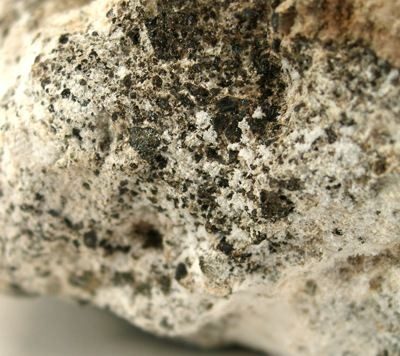
Stevensite Locality: Långban , Filipstad , Värmland , Sweden ( Locality at mindat.org ) Size: 8.9 x 5.9 x 4.4 cm. First identified in specimens from a railway tunnel at Bergen Hill in Hudson County, New Jersey, (Ca0.5,Na)0.33(Mg,Fe++)3Si4O10(OH)2•n(H2O), Stevensite is a little-known phyllosilicate in the smectite group. This is an old specimen from Langban - accompanied by an old label calling it "Aphrodite." — Photo: Robert M. Lavinsky · CC BY-SA 3.0
Stevensite
A white smectite clay of hydrated magnesium silicate — an alteration product in magnesium-rich environments.
Intro adapted from Wikipedia (CC BY-SA).
Stevensite is an IMA-recognized mineral species in the silicate class, with the chemical formula (Ca,Na)ₓMg₃₋ᵧSi₄O₁₀(OH)₂.
It is a member of the Clay structural group.
Key properties: Mohs hardness 2.5; specific gravity 2.15–2.56; Dull to resinous luster.
IMA symbol Stv, IMA status: questionable, named in 1873.
Found in cavities in basalt, formed by late-stage hydrothermal replacement of pectolite. A hydrothermal alteration product of igneous rocks, as dunite and tuff. can form authigenically, interstratified with other species.
It is found associated with Quartz, talc, pectolite.
The name refers to E.A. Stevens, founder, Stevens Institute of Technology, Hoboken, New Jersey, USA.