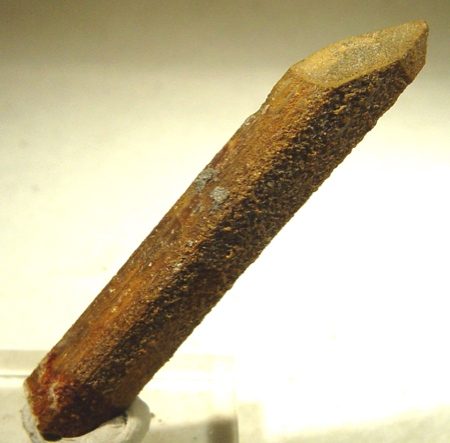
Stibiconite Locality: Catorce (Real de Catorce), Municipio de Catorce , San Luis Potosí , Mexico ( Locality at mindat.org ) A sharp stibnite crystal that has been replaced by the mineral stibiconite, retaining the original form perfectly. These are not the most beautiful of mineral specimens, but they deserve respect as a classic from San Luis Potosi. 7 x 1 x 0.8 cm — Photo: Robert M. Lavinsky · CC BY-SA 3.0
Stibiconite
An antimony oxide — 'antimony ochre' — the yellow alteration product of stibnite.
Intro adapted from Wikipedia (CC BY-SA).
Stibiconite is an IMA-recognized mineral species in the oxides & hydroxide class, with the chemical formula Sb³⁺Sb⁵⁺₂O₆(OH).
It crystallizes in the cubic crystal system (space group Fd3m). It is a member of the Pyrochlore structural group.
Key properties: Mohs hardness 5.5–7; specific gravity 3.3–5.5; Pearly, opaline, glassy to earthy luster.
IMA symbol Sbc, IMA status: questionable, named in 1832.
Found as a secondary mineral in hydrothermal mineral deposits, formed by the oxidation of other antimony-bearing minerals, commonly stibnite, which it may entirely replace.
It is found associated with Cervantite, valentinite, kermesite, antimony, stibnite.
The name comes from the Latin for antimony, STIBIum, and the Greek for powder or dust, a common habit.