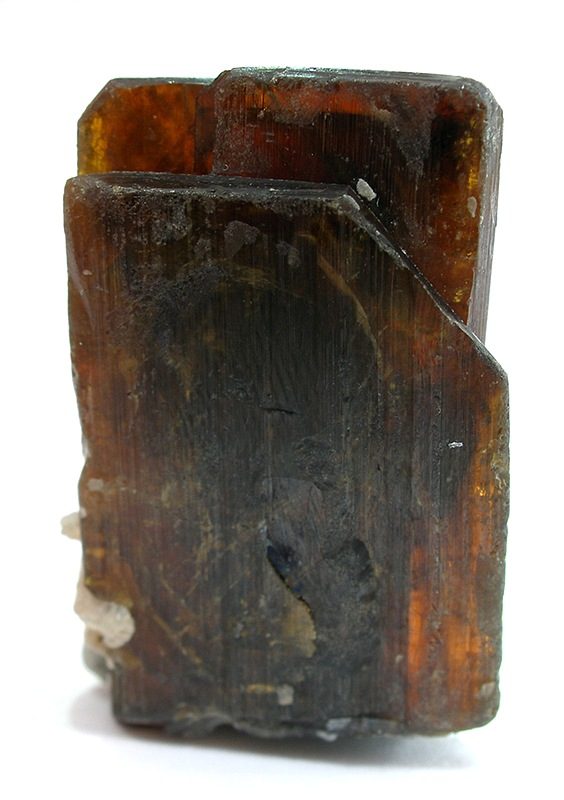
Stibiotantalite Locality: Himalaya Mine (Himalaya pegmatite; Himalaya dikes), Gem Hill, Mesa Grande District, San Diego County , California , USA ( Locality at mindat.org ) Size: thumbnail, 3.2 x 2.1 x 0.6 cm Stibiotantalite This perfect, equant, textbook-quality crystal is a very significant example of this rare species for San Diego, of which few better exist. I recall the handwringing it caused when Chuck traded this from Irv Brown in the mid-1990s. By any standard, this is a beautiful example of the species from any US locale. Ex. Chuck Houser Collection. — Photo: Robert M. Lavinsky · CC BY-SA 3.0
Stibiotantalite
The tantalum end of the stibiotantalite-stibiocolumbite series — a heavy mineral of complex pegmatites.
Intro adapted from Wikipedia (CC BY-SA).
Stibiotantalite is an IMA-recognized mineral species in the oxides & hydroxide class, with the chemical formula Sb³⁺TaO₄.
It crystallizes in the orthorhombic crystal system (space group Pbn2_1).
Key properties: Mohs hardness 5.5; specific gravity 7.53; Pale yellow to yellow-brown streak; Resinous to adamantine luster; optically biaxial.
IMA symbol Sttl, grandfathered status — known before the IMA’s founding, named in 1893.
Occurs as an uncommon accessory mineral in complex granite pegmatites.
It is found associated with Tantalite (Greenbushes, Western Australia); antimony, allemontite, microlite, stibiomicrolite, lithiophilite, alkalic beryl, cassiterite.
The name comes from the Latin for antimony, STIBIum, in the composition, and relation to tantalite.