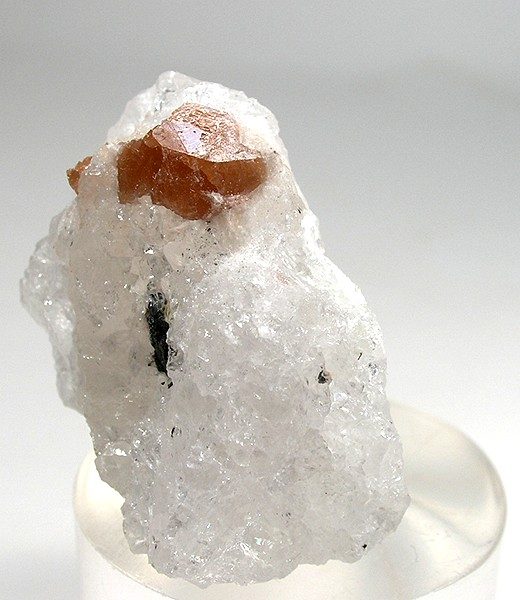
Stillwellite-(Ce) Locality: Darai-Pioz (Dara-i-Pioz; Dara-Pioz) Glacier, Alai (Alayskiy) Range, Tien Shan Mts, Region of Republican Subordination , Tajikistan ( Locality at mindat.org ) This is one of the better crystals collected in a remakrable pocket from a glacial region, in september of 2004. It features a 1.3 cm crystal in matrix. Interestingly, they COLOR CHANGE from red (as shown) in halogen or sunlight to YELLOW in fluorescent light. Superb crystal form and lustre for the species, as well as unusually attractive for such a normally earthy species. They are translucent and partly gemmy, if not transparent per se. 4 x 2.3 x 2.1 cm — Photo: Robert M. Lavinsky · CC BY-SA 3.0
Stillwellite-(Ce)
Stillwellite-(Ce) is a rare-earth boro-silicate mineral with chemical formula (Ce,La,Ca)BSiO5.
Intro adapted from Wikipedia (CC BY-SA).
Stillwellite-(Ce) is an IMA-recognized mineral species in the silicate class, with the chemical formula CeBSiO₅.
It crystallizes in the hexagonal crystal system (space group P3_1).
Key properties: Mohs hardness 6.5; specific gravity 4.57–4.6; White streak; refractive index 1.773; optically uniaxial.
IMA symbol Swl-Ce, IMA status: approved, named in 1955.
Locally abundant as a metasomatic replacement of metamorphosed calcareous sediments (Mary Kathleen mine, Australia); in alkalic pegmatites in syenite in an alkalic massif (Dara-i-Pioz massif, Ta jikistan).
It is found associated with Allanite, garnet, uraninite (Mary Kathleen mine, Australia); calcite, monazite, bastnÄa site, thorite, uranothorite, thorianite (Desmont mine, Canada).
The name refers to Dr. Frank Leslie Stillwell (1888–1963), Australian ore mineralogist, and its predominant cerium content.