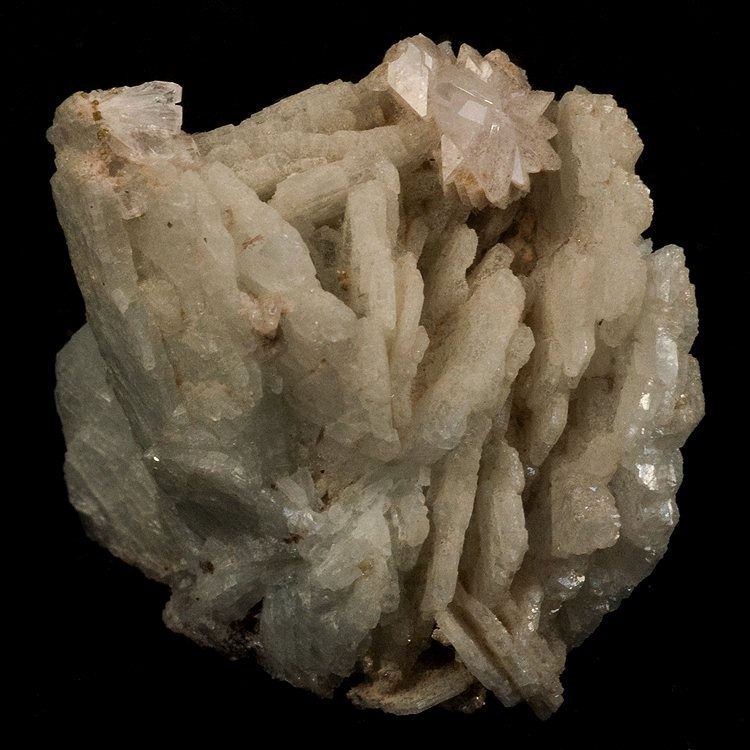
Stokesite , Albite (Var.: Cleavelandite ) Locality: Urucum mine (Tim mine; Córrego do Urucum pegmatite), Galiléia , Doce valley, Minas Gerais , Southeast Region, Brazil ( Locality at mindat.org ) Size: 3.1 x 2.5 x 2.4 cm. Stokesite is a very rare calcium, tin silicate. A gorgeous little 1.0 cm radial spray of glassy stokesite crystals is beautifully perched atop a cluster of pearlescent, parallel-growth cleavelandite blades. This excellent specimen is from the Corrego do Urucum pegmatite of Brazil and is a very uncommon, gemmy spray of the species. Most Urucum stokesites are spherical, radial aggregates. Older material, from Carlos Barbosa, back in the late 1990s. — Photo: Robert M. Lavinsky · CC BY-SA 3.0
Stokesite
Stokesite is an IMA-recognized mineral species in the silicate class, with the chemical formula CaSnSi₃O₉·2H₂O.
It crystallizes in the orthorhombic crystal system (space group Pnna).
Key properties: Mohs hardness 6; specific gravity 3.185; White streak; Vitreous, pearly on {100} luster; optically biaxial.
IMA symbol Sks, grandfathered status — known before the IMA’s founding, named in 1900.
On axinite (Roscommon Cliff, England); in miarolitic cavities in a quartz-albite pegmatite (V·e·zn¶a, Czech Republic).
It is found associated with Axinite, cassiterite (Roscommon Cliff, England); albite, titanite, beryl, microlite, quartz (Corr¶ego do Urucum, Brazil).
The name refers to Sir George Gabriel Stokes (1819–1903), Professor of Mathematics, Cambridge University, Cambridge, England.