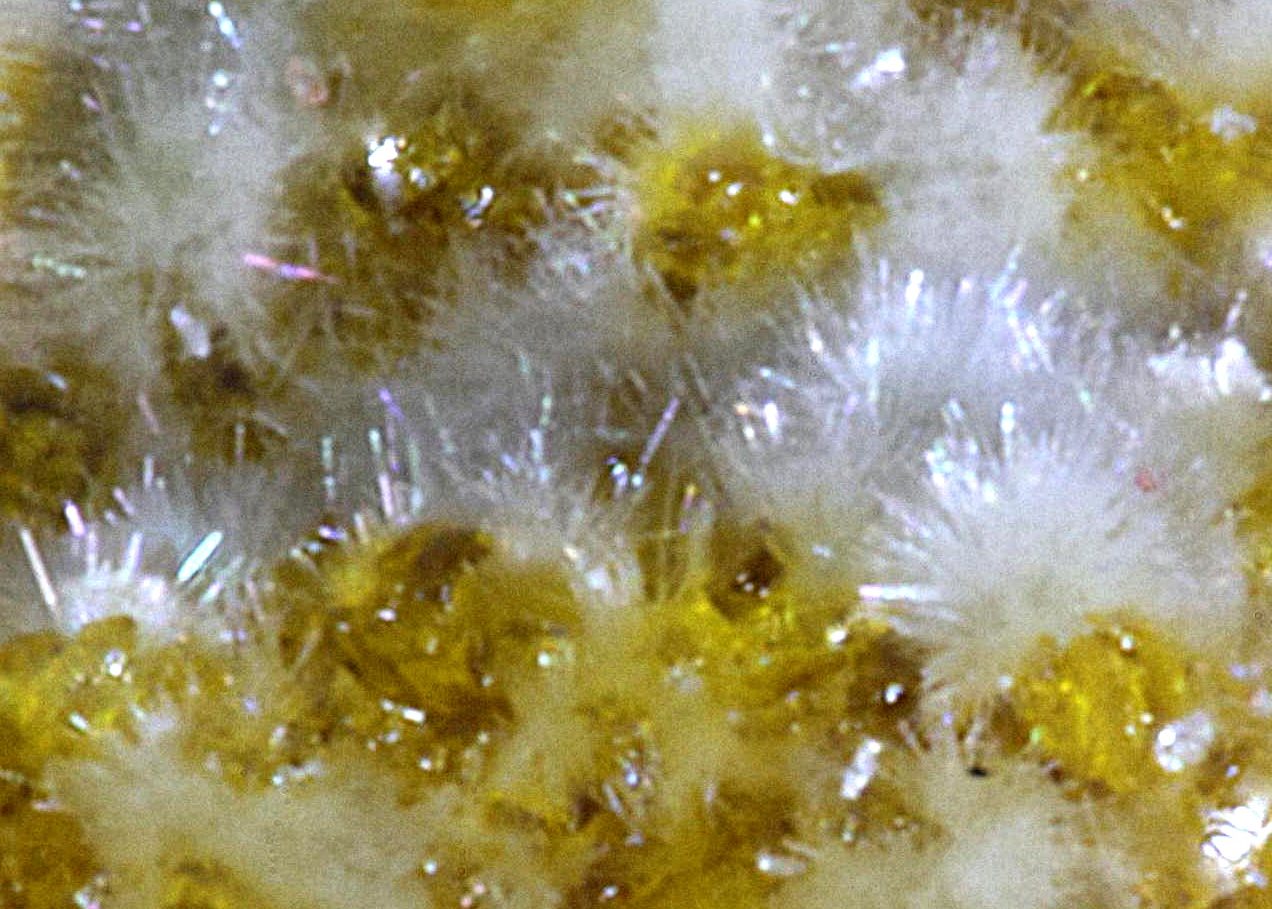
Paragenisis of studtite (white, fine needles) with billietite (yellow crystals) from Menzenschwand, Germany (width: 3 mm) — Photo: Klaproth · CC0
Studtite
A pale-yellow uranyl peroxide — a secondary uranium mineral created when radiation splits water.
Intro adapted from Wikipedia (CC BY-SA).
Studtite is an IMA-recognized mineral species in the oxides & hydroxide class, with the chemical formula (UO₂)(O₂)(H₂O)₂·2H₂O.
It crystallizes in the monoclinic crystal system (space group C2/c).
Key properties: Mohs hardness 1.5; specific gravity 3.58; Vitreous luster; refractive index 1.593; optically biaxial.
IMA symbol Stu, grandfathered status — known before the IMA’s founding, named in 1947.
A very rare mineral found in the oxidized zone of some uranium-bearing mineral deposits.
It is found associated with Uranophane, rutherfordine, lepersonnite (Shinkolobwe, Congo); billietite, uranophane, rutherfordine, heisenbergite, baryte, quartz, hematite.
The mineral was named to honor Franz Edward Studt, geologist, who published a geological map of Shaba (Katanga) Province in 1913.