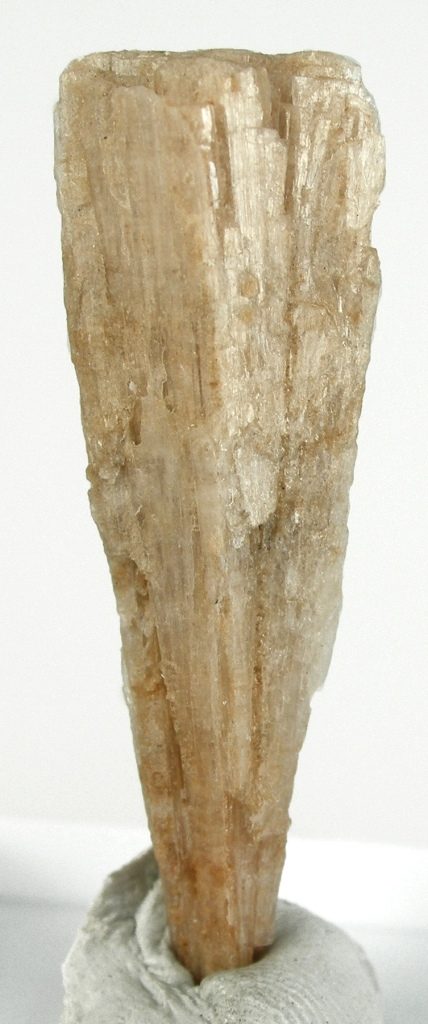
Syngenite Locality: Niedersachsen Potash Works, Wathlingen , Celle , Lower Saxony , Germany ( Locality at mindat.org ) Size: 4.4 x 1.3 x 0.6 cm. A sharp, tapering crystal with a broad, chisel-like termination. Syngenite is a potassium, calcium sulfate, rarely forming good crystals in this size. — Photo: Robert M. Lavinsky · CC BY-SA 3.0
Syngenite
A potassium-calcium sulfate forming monoclinic prisms and crusts in evaporites and lava tubes.
Intro adapted from Wikipedia (CC BY-SA).
Syngenite is an IMA-recognized mineral species in the sulfate class, with the chemical formula K₂Ca(SO₄)₂·H₂O.
It crystallizes in the monoclinic crystal system (space group P2_1/m). It is a member of the Syngenite structural group.
Key properties: Mohs hardness 2.5; specific gravity 2.58–2.6; Vitreous luster; refractive index 1.512; optically biaxial.
IMA symbol Sgn, grandfathered status — known before the IMA’s founding, named in 1872.
An uncommon diagenetic component of marine salt deposits; a volcanic sublimate or pneumatolytic reaction product; a hydrothermal vein filling in a geothermal field; derived from bat guano in caves.
It is found associated with Halite, arcanite (salt deposits); biphosphammite, aphthitalite, monetite, whitlockite, uricite, brushite, gypsum (caves).
Its name comes from the Greek for related, for the chemical resemblance to polyhalite.