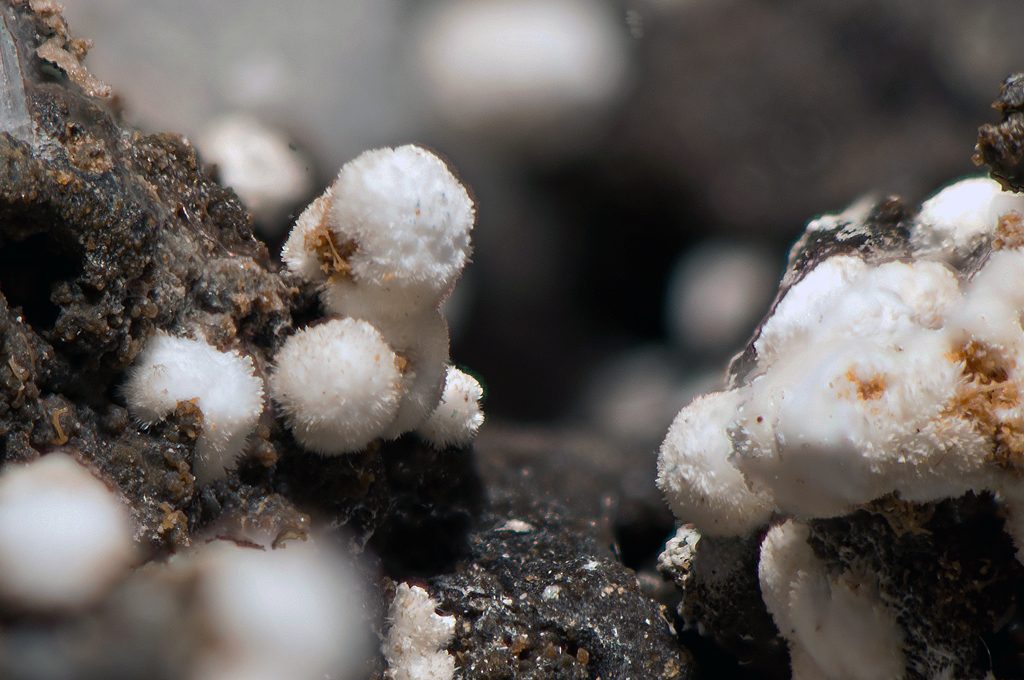
Tacharanite Locality: Palagonia, Northern Iblean plateau, Catania Province, Sicily, Italy Original description: Spheres of diameter 2,5 mm. Collection and photo of Gianfranco ciccolini — Photo: Gianfranco Ciccolini · Public domain
Tacharanite
A calcium-aluminium silicate hydrate akin to tobermorite — a product of altered basic igneous rocks.
Intro adapted from Wikipedia (CC BY-SA).
Tacharanite is an IMA-recognized mineral species in the silicate class, with the chemical formula Ca₁₂Al₂Si₁₈O₃₃(OH)₃₆.
It crystallizes in the monoclinic crystal system.
Key properties: specific gravity 2.33–2.36; Vitreous to dull luster.
IMA symbol Tch, grandfathered status — known before the IMA’s founding, named in 1961.
Found in amygdules and fractures in metabasalts and basaltic breccias; in hydrothermally altered quartzite inclusions in basalt (Bramburg, Germany).
It is found associated with Tobermorite, gyrolite, mesolite, thomsonite, xonotlite, calcite, saponite (Portree, Scotland); scawtite (Huntley, Scotland).
The name comes from the Gaelic tacharan for changeling, as the mineral converts to others on exposure to air.