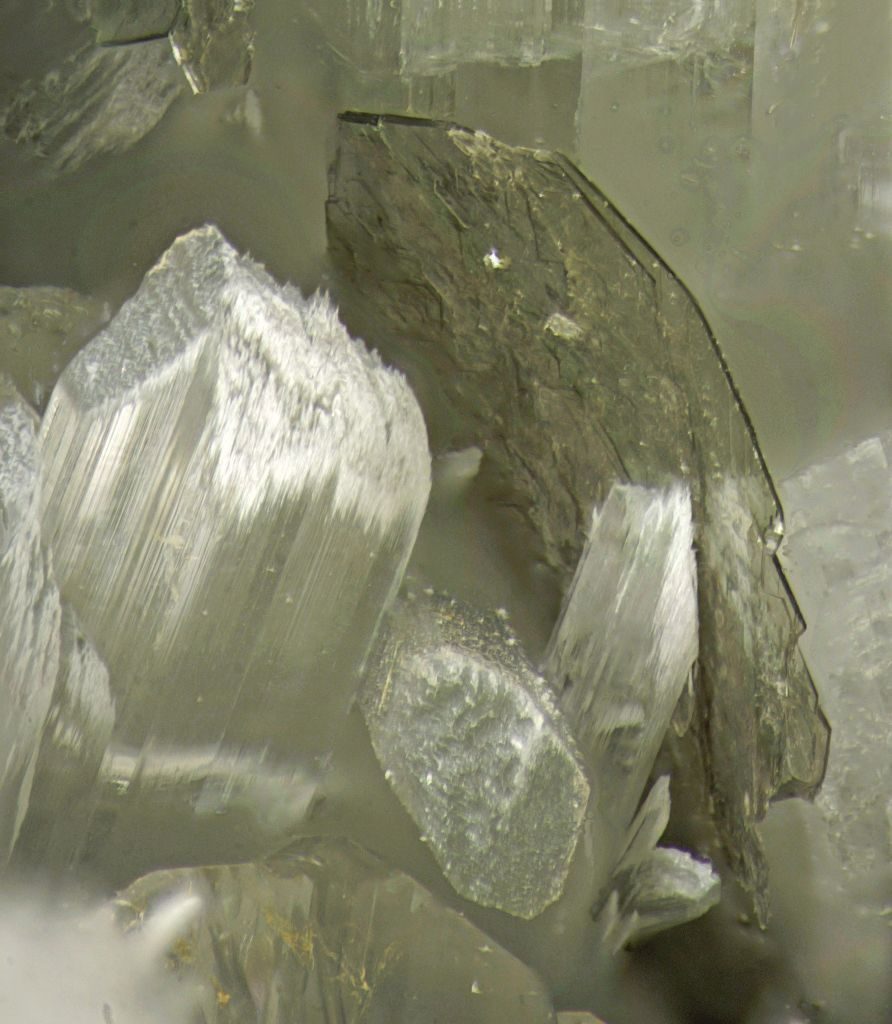
The tainiolite xl spans ~ 2 mm. Found April 2000 (Poudrette quarry, Mont Saint-Hilaire, La Vallée-du-Richelieu RCM, Montérégie, Québec, Canada). MOB coll. This is the most euhedral xl on the specimen but it’s most inconveniently stuck in a cavity behind pectolite xls with fibrous terminations. The tainiolite is actually pale greenish/tan/gray with a silvery luster but it wasn’t possible to show that in this view. The tainiolite does not fluoresce – i.e. it isn’t polylithionite. But it is exceptionally well formed for the species at MSH. From the same (visually) verified find as http://www.mindat.org/photo-471616.html There is a stereo child photo. — Photo: Modris Baum · CC0
Tainiolite
Tainiolite is an IMA-recognized mineral species in the silicate class, with the chemical formula KLiMg₂Si₄O₁₀F₂.
It crystallizes in the monoclinic crystal system (space group C2/m). It is a member of the Mica structural group.
Key properties: Mohs hardness 2.5–3.5; specific gravity 2.83–2.9; Vitreous, silky luster; optically biaxial.
IMA symbol Tai, grandfathered status — known before the IMA’s founding, named in 1901.
A late-stage mineral in nepheline syenite pegmatites.
It is found associated with Quartz, dickite (Narss^a rssuk, Greenland); natrolite, apatite, neptunite, polylithionite, manganoan pectolite (Lovozero massif, Russia); natrolite, pectolite.
Its name comes from the Greek for ribbon in reference to the mineral's tabular crystals.