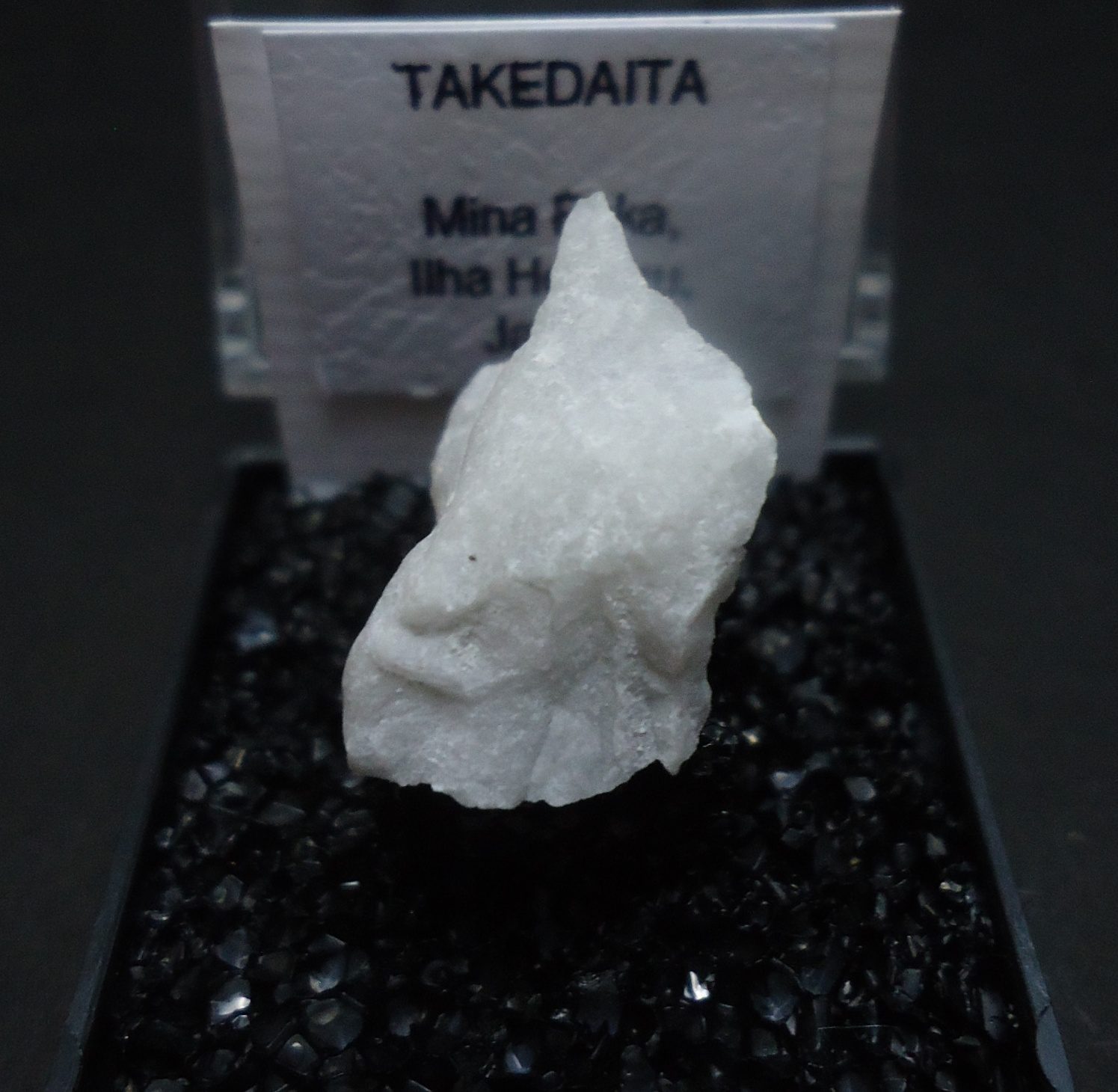
Locality: Fuka mine, Fuka, Bicchu-cho (Bitchu-cho), Takahashi City, Okayama Prefecture, Chugoku Region, Honshu Island, Japan Dimensions: 16 mm x 9 mm x 8 mm White massive Takedaite from type locality; photo and collection Fernando Brederodes. — Photo: Fernando Brederodes · CC0
Takedaite
A calcium borate found in 1994 at Japan's Fuka mine, alongside nifontovite and olshanskyite.
Intro adapted from Wikipedia (CC BY-SA).
Takedaite is an IMA-recognized mineral species in the borate class, with the chemical formula Ca₃B₂O₆.
It crystallizes in the hexagonal crystal system (space group R-3c).
Key properties: Mohs hardness 4.5; specific gravity 3.1; Vitreous luster; optically uniaxial.
IMA symbol Tkd, IMA status: approved, named in 1993.
A rare mineral probably formed by boron-rich fluids reacting between crystalline limestone and gehlenite-spurrite skarns.
It is found associated with Frolovite, nifontovite, olshanskyite, pentahydroborite, sibirskite, calcite.
The mineral was named to honor Professor Hiroshi Takeda (1934–), mineralogist, University of Tokyo, Tokyo, Japan.