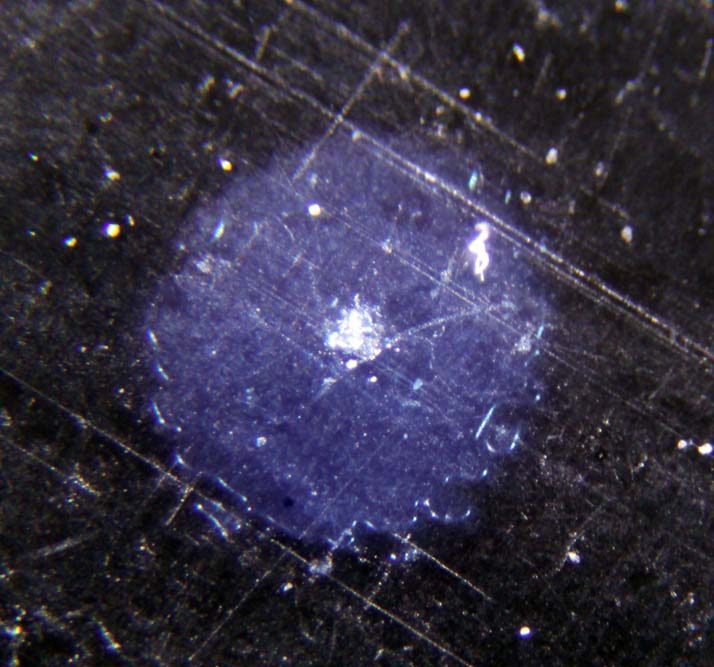
Unpolished microprobe preparate with a 0,20 x 0,15 x 0,10 mm grain of bronze-pinkish Tantalcarbide from the type and only known locality worldwide (Avrorinskii Placer, Aktai River, Baranchinsky Massif, Nizhnii Tagil, Sverdlovsk Oblast, Russian Federation), completely analyzed. The exact formula of this specimen is (Ta0,80Nb0,20)C. Part of holotype, portion of original material sold by Krantz to FMM in 1912 and collected at the beginning of XX century. This material was investigated and led to an article describing the new isomorphous series TaC-NbC from platinum placers of the Urals. — Photo: David Hospital · CC BY-SA 4.0
Tantalcarbide
Natural tantalum carbide — an extremely hard, rare isometric mineral.
Intro adapted from Wikipedia (CC BY-SA).
Tantalcarbide is an IMA-recognized mineral species in the organic mineral class, with the chemical formula TaC.
It crystallizes in the cubic crystal system (space group Fm3m).
Key properties: Mohs hardness 6–7; specific gravity 14.5; Metallic luster; optically isotropic.
IMA symbol Tcb, grandfathered status — known before the IMA’s founding, named in 1909.
Found in placer concentrates from a “gold-washing operation”. Suspected to be a synthetic compound mixed with natural placer concentrate. No in situ localities known.
It is found associated with Native gold, α-Fe, nickel, Fe-Ta-Nb, Fe-Sn alloys, and apatite, Ti-magnetite, dolomite, zircon, wüstite, serpentine, graphite - as inclusions.
The name refers to its essential chemical components: tantalum and carbide.