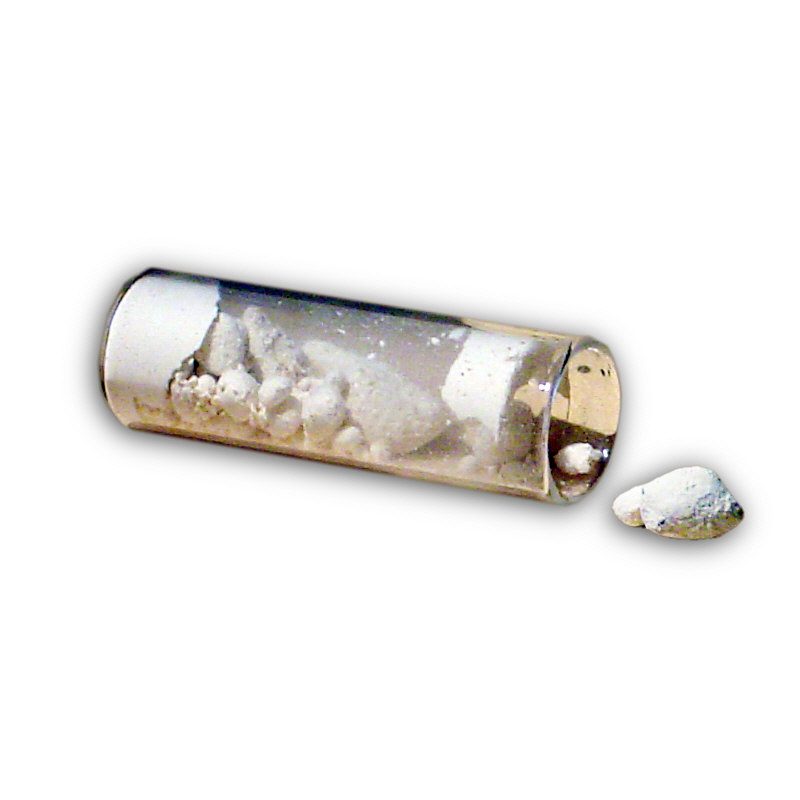
These mineral images are free to use how you wish. — Photo: Dave Dyet http://www.shutterstone.com http://www.dyet.com · Public domain
Taranakite
A hydrated potassium-aluminium-iron phosphate formed where guano meets clay — the classic 'guano mineral'.
Intro adapted from Wikipedia (CC BY-SA).
Taranakite is an IMA-recognized mineral species in the phosphate class, with the chemical formula K₃Al₅(PO₃OH)₆(PO₄)₂·18H₂O.
It crystallizes in the hexagonal crystal system (space group R-3c). It is a member of the Taranakite structural group.
Key properties: Mohs hardness 1.5; specific gravity 2.12–2.15; refractive index 1.505; optically uniaxial.
IMA symbol Tar, grandfathered status — known before the IMA’s founding, named in 1865.
Formed from phosphatic solutions derived from bird or bat guano reacting with clays or aluminous rocks under perenially damp conditions; the most common phosphate mineral in caves.
It is found associated with Vashegyite, leucophosphite, minyulite, francoanellite, brushite, ardealite, strengite, variscite, vivianite.
The name refers to its first recognized occurrence on the Taranaki Peninsula, New Zealand.