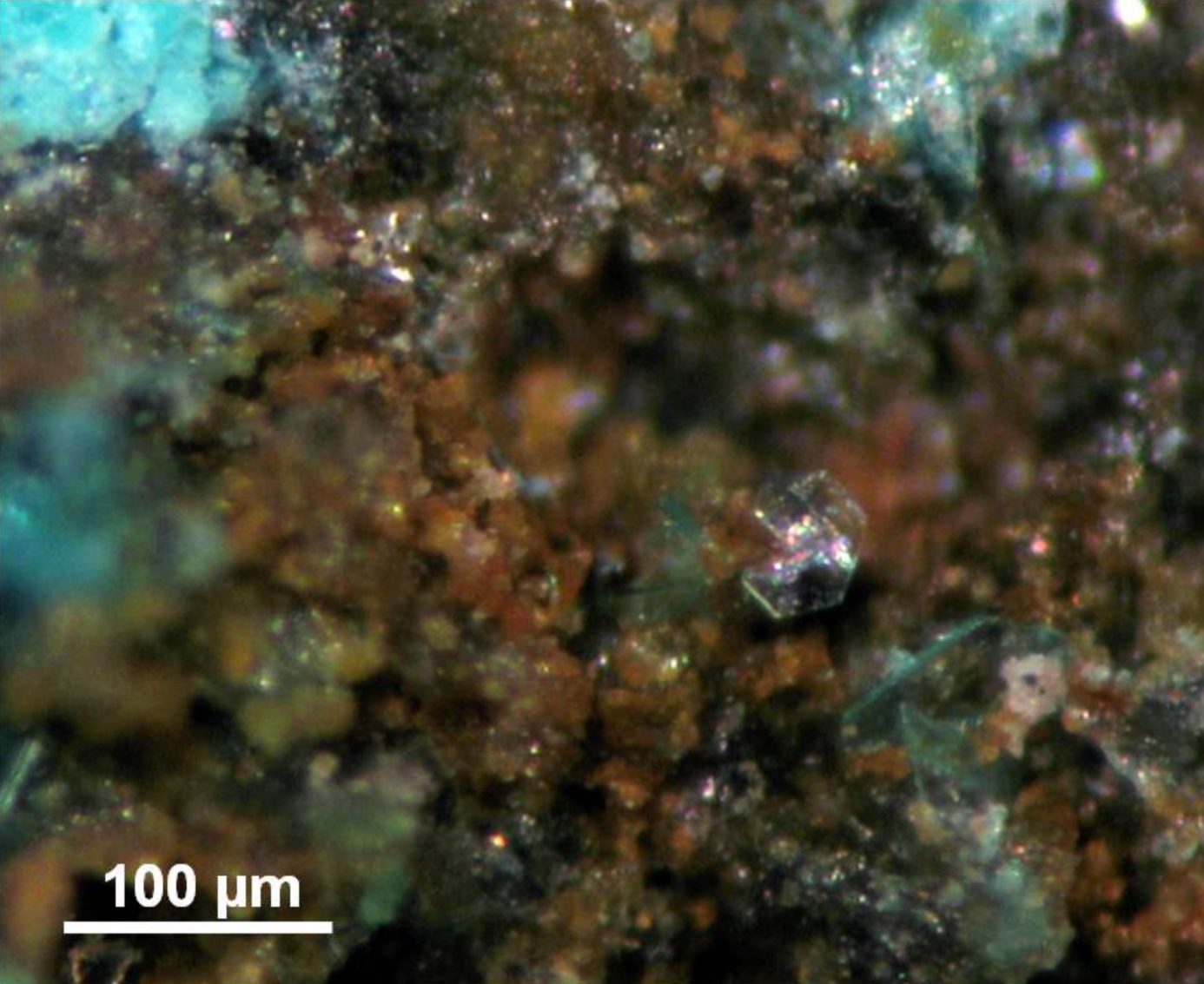
Tiberiobardiite, thin, pseudo-hexagonal crystals, up to 40 µm in size, with iron oxides. Cretaio, Prata, Massa Marittima, Grosseto, Tuscany. Holotype specimen, #19900, collection of the Museo di Storia Naturale of the University of Pisa. Image obtained from: Biagioni, C., Pasero, M., Zaccarini, F. (2018) Tiberiobardiite, Cu9Al(SiO3OH)2(OH)12(H2O)6(SO4)1.5·10H2O, a New Mineral Related to Chalcophyllite from the Cretaio Cu Prospect, Massa Marittima, Grosseto (Tuscany, Italy): Occurrence and Crystal Structure. Minerals 2018: 8(4): 152. https://doi.org/10.3390/min8040152 The article is an open access article distributed under the Creative Commons Attribution License which permits unrestricted use, distribution, and reproduction in any medium, provided the original work is properly cited. (CC BY 4.0).” — Photo: Ronnie Van Dommelen · CC BY 4.0
Tiberiobardiite
Tiberiobardiite is an IMA-recognized mineral species in the silicate class, with the chemical formula {Cu₉Al[SiO₃(OH)]₂(OH)₁₂(H₂O)₆}(SO₄)₁.₅·10H₂O.
It crystallizes in the hexagonal crystal system (space group R-3). It is a member of the Chalcophyllite structural group.
Key properties: Mohs hardness 2.528; specific gravity 2.528; Pale green streak; Vitreous luster.
IMA symbol Tbd, IMA status: approved, named in 2016.
The product of supergene alteration of Cu sulfide minerals (bornite, chalcocite, and covellite) in stockwork veins in deformed gabbro, in an oxidizing and hydrous low-temperature environment.
It is found associated with Brochantite.
The mineral was named to honor mineral collector Tiberio Bardi (b.1960), for his contributions to the study of Tuscan mineralogy and for collecting the first specimens of this new mineral.