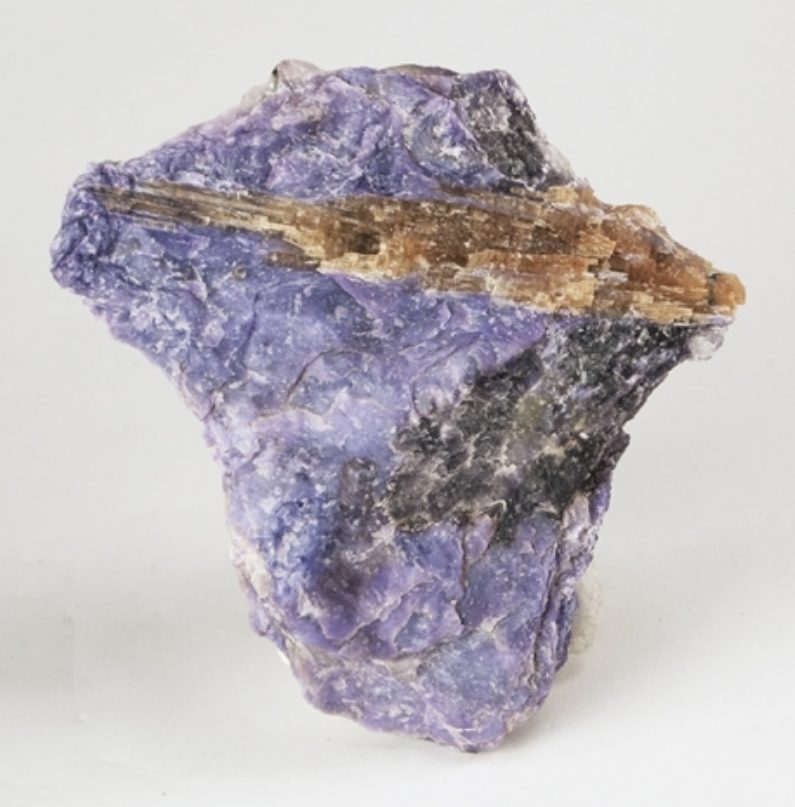
7.9 x 7.9 x 1.3 cm. Tinaksite and charosite are very rare complex silicates and the Murunskii Massif is the Type Locality for these colorful species (Chara and Tokko Rivers Confluence, Aldan Shield, Sakha Republic, Russia). An impressive, 7.8 cm tapered column of parallel-growth, lustrous and translucent, honey-brown tinaksite crystals is aesthetically set in a very colorful, rich lilac, foliated plate of waxy charoite. A fine, showy and rich combination specimen of these rarities from the Fersman Museum in Moscow. The label is from the Soviet era. — Photo: Robert M. Lavinsky · CC BY-SA 3.0
Tinaksite
A yellow-orange titanium silicate of Russia's Murun massif — a common companion of charoite.
Intro adapted from Wikipedia (CC BY-SA).
Tinaksite is an IMA-recognized mineral species in the silicate class, with the chemical formula K₂NaCa₂TiSi₇O₁₈(OH)O.
It crystallizes in the triclinic crystal system (space group P-1).
Key properties: Mohs hardness 6; specific gravity 2.82–2.9; Vitreous on cleavages luster; refractive index 1.627; optically biaxial.
IMA symbol Tnk, IMA status: approved, named in 1965.
An accessory mineral in potassic feldspar metasomatites at the contact with limestones (Murun massif, Russia).
It is found associated with Potassic feldspar, aegirine, quartz, canasite, xonotlite (Murun massif, Russia); orthoclase, pyroxene, aegirine, astrophyllite, hisingerite (Khibiny massif.
The name refers to the Ti, Na, K, Si in the composition.