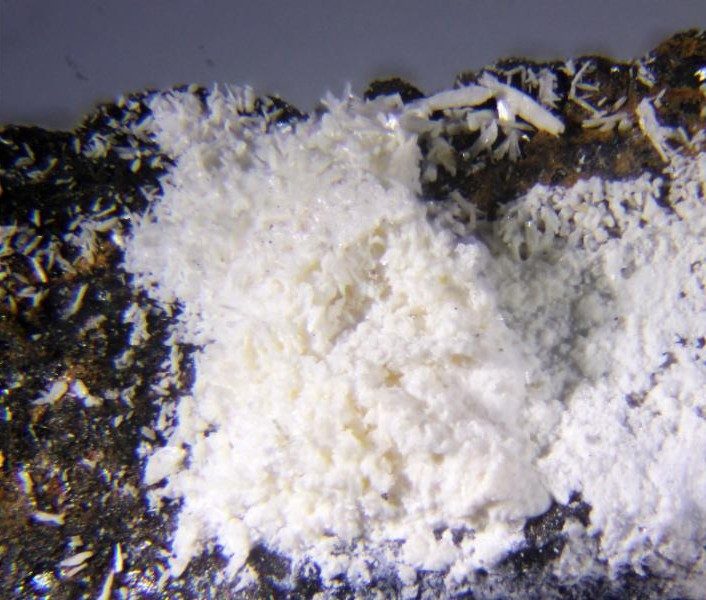
Outstanding white crystals of the very rare organic mineral tinnunculite from one of the few known localities worldwide: Laurenburg, Diez, Rhein-Lahn, Rhineland-Palatinate, Germany. Analyzed by XRD (ref. A993). A naturally occurring dihydrate of uricite (uric acid) to which it is visually very similar. Ex. Erich Laskowski collection (USA). — Photo: David Hospital · CC BY 4.0
Tinnunculite
Natural uric acid dihydrate — an organic mineral formed from falcon droppings on burning coal dumps.
Intro adapted from Wikipedia (CC BY-SA).
Tinnunculite is an IMA-recognized mineral species in the organic mineral class, with the chemical formula C₅H₄N₄O₃·2H₂O.
It crystallizes in the monoclinic crystal system (space group P2_1/c).
Key properties: specific gravity 1.68; Vitreous luster; optically biaxial.
IMA symbol Tnn, IMA status: approved, named in 2015.
From the crystallization of uric acid in bird excrement in a cold and humid Arctic climate (Kola) or through reaction with hot gases on a burning coal mine slagheap (South Urals).
The name refers to the scientific name for the bird species (Falco tinnunculus L.) responsible for the guano essential to the formation of the mineral on a burning slagheap (Kopeisk, South Urals.