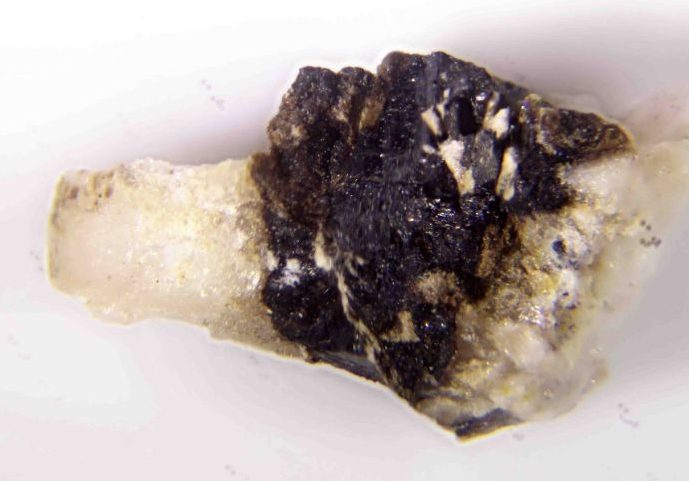
White crystal group of the intermediate member torreyite-lawsonbauerite from the type and only known locality worldwide in Franklin (Sterling Mine, Ogdensburg, Sussex County, New Jersey, United States of America), in an analyzed specimen by SEM/EDS (Mg was detected but not quantified, small peak at 1,2). Percentages of chemical elements in the analysis are only approximate since the sample was not carbon coated to avoid soiling of the specimen. After the analysis we can see the sample is closer to the end member lawsonbauerite rather than torreyite. Eventhough, the sample was originally labeled as only torreyite, so I assume other points in the sample not detected are more Mg rich. Ex Vandenbroucke Museum collection from Waregem, Belgium. — Photo: David Hospital · CC BY-SA 4.0
Torreyite
Torreyite is an IMA-recognized mineral species in the sulfate class, with the chemical formula Mg₉Zn₄(SO₄)₂(OH)₂₂·8H₂O.
Key properties: Mohs hardness 3; specific gravity 2.665; Vitreous to almost pearly, dull luster; optically biaxial.
IMA symbol Try, grandfathered status — known before the IMA’s founding, named in 1949.
Very rare, in veinlets cutting calcite–franklinite–willemite ore in a metamorphosed stratiform zinc orebody.
It is found associated with Mooreite, fluoborite, pyrochroite, sussexite, rhodochrosite, zincite, franklinite, willemite, calcite.
The mineral was named to honor Dr. John Torrey (1796–1873), American naturalist who early studied Franklin, New Jersey, USA minerals.