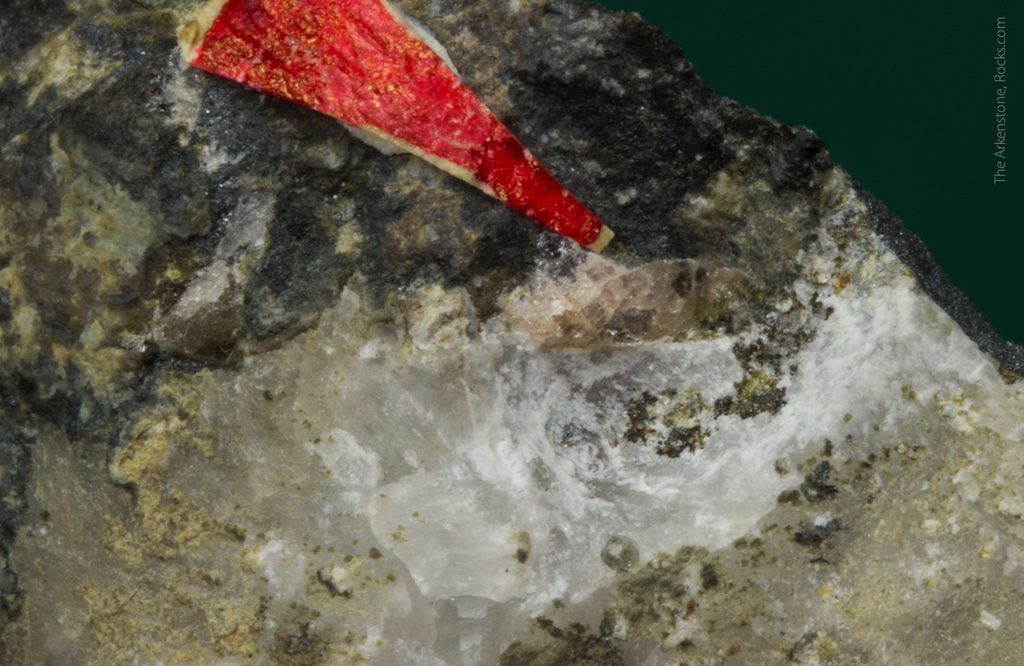
Locality: Långban, Filipstad, Värmland, Sweden Dimensions: 7.0 cm x 6.0 cm x 2.5 cm A very good example of this rare calcium manganese beryllium silicate. Trimerite occurs as subhedral, prismatic, yellow-orange crystals to 3mm along the margin of a calcite veinlet in manganite ore. The largest and most significant, nearly complete crystal (3 mm) is marked with a red arrow. From Langban, Filipstad, Varmland, Sweden. Ex. Swedish Natural History Museum collection with label. — Photo: Robert M. Lavinsky · CC BY-SA 3.0
Trimerite
Trimerite is an IMA-recognized mineral species in the silicate class, with the chemical formula CaBe₃Mn²⁺₂(SiO₄)₃.
It crystallizes in the monoclinic crystal system (space group P2_1/n). It is a member of the Beryllonite structural group.
Key properties: Mohs hardness 6–7; specific gravity 3.474; Vitreous, brilliant luster; optically biaxial.
IMA symbol Tme, grandfathered status — known before the IMA’s founding, named in 1890.
A rare mineral, probably developed during late-stage hydrothermal activity in association with contact metamorphism and metasomatism.
It is found associated with Calcite, hematite.
Its name comes from the Greek for three parts, in allusion to the trilling twinning and associated optical effects.