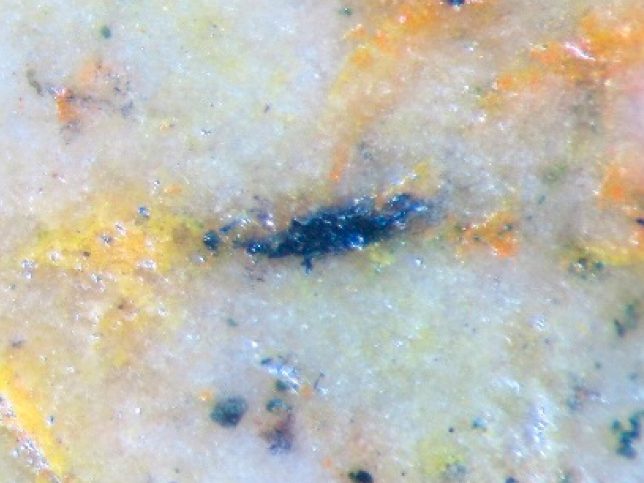
Black elongated grain of tsygankoite with metallic lustre and alabandite (in the center) in white dolomite-calcite matrix along with orpiment (yellow) and native arsenic (black rounded grain on the right). This grain of tsygankoite was extracted from the polished section and used for the structure data collection. Image obtained from: Kasatkin, A.V., Makovicky, E., Plášil, J., Škoda, R., Agakhanov, A.A, Karpenko, V.Y. and Nestola, F. (2018) Tsygankoite, Mn8Tl8Hg2(Sb21Pb2Tl)S24S48, a New Sulfosalt from the Vorontsovskoe Gold Deposit, Northern Urals, Russia. Minerals: 8(5): 218; doi.org/10.3390/min8050218 The article is an open access article distributed under the Creative Commons Attribution License which permits unrestricted use, distribution, and reproduction in any medium, provided the original work is properly cited. (CC BY 4.0). — Photo: Kasatkin, A.V., Makovicky, E., Plášil, J., Škoda, R., Agakhanov, A.A, Karpenko, V.Y. and Nestola, F. · CC BY 4.0
Tsygankoite
Tsygankoite is an IMA-recognized mineral species in the sulfosalt class, with the chemical formula Mn₈Tl₈Hg₂(Sb₂₁Pb₂Tl)S₄₈.
It crystallizes in the monoclinic crystal system (space group C2/c).
Key properties: Mohs hardness 3; specific gravity 5.45; Black streak; Metallic luster.
IMA symbol Tsy, IMA status: approved, named in 2018.
Found in mineralized limestone breccias (calcite-dolomite, up to 85% of volume) in the ores of the sulfide-carbonate type in a gold deposit of uncertain origin.
It is found associated with Aktashite, arsenopyrite, barite, cinnabar, fluorapatite, orpiment, pyrite, realgar, routhierite, sphalerite, tilasite, titanite, calcite, dolomite.
The mineral was named to honor Mikhail Vladimirovich Tsyganko (b. 1979), a mineral collector from Severouralsk, Sverdlovskaya Oblast’, Northern Urals.