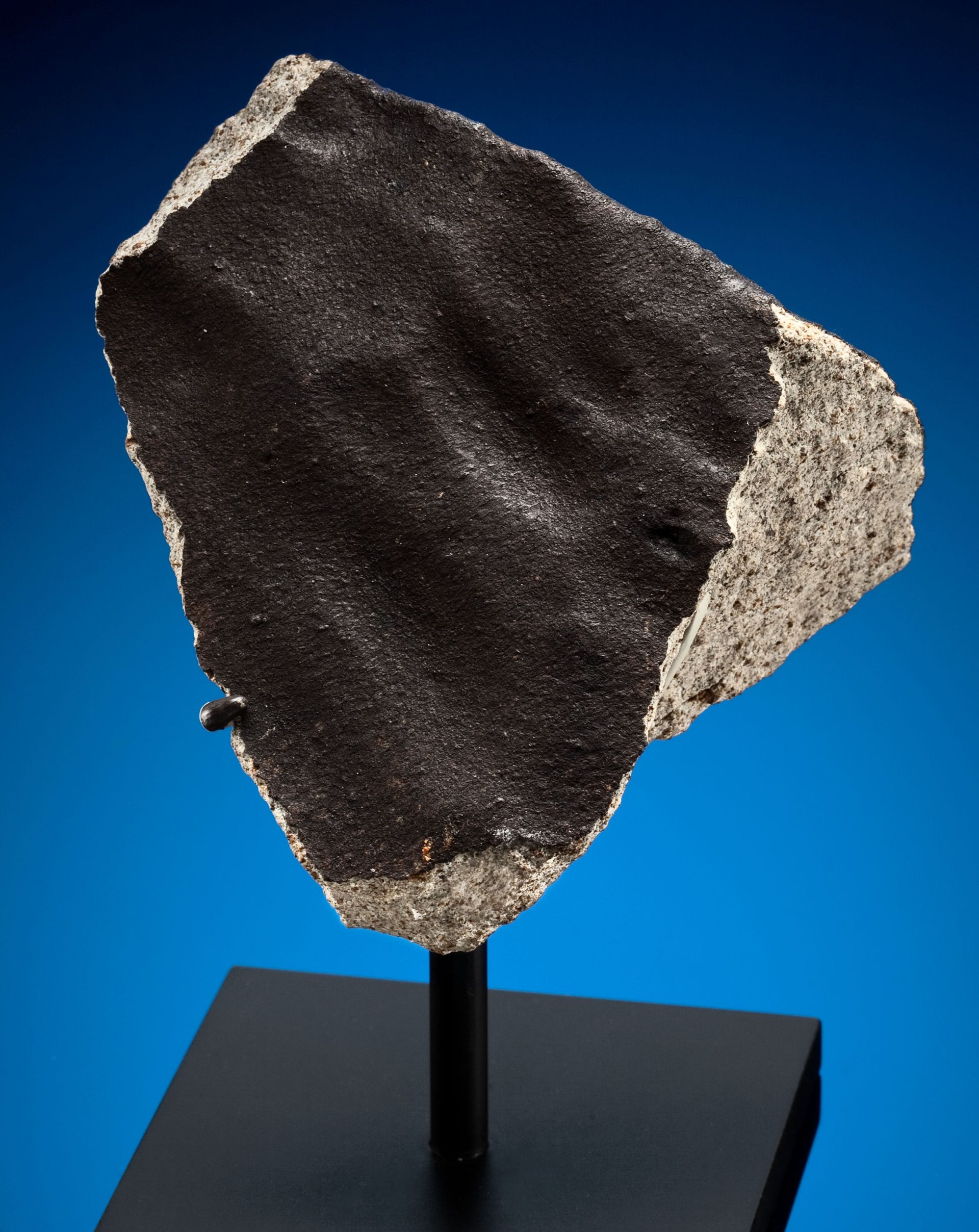
The Suizhou meteorite shower occurred on April 15, 1986 in Dayanpo, Suizhou Prefecture, Hubei Province at 6:50pm, a witnessed fall. Suizhou is most widely known for containing a mineral never before seen in nature. Found in the thin veins of shock melt which run through Suizhou — the result of a cataclysmic collision in outer space— is Tuite, a new polymorph of the mineral Whitlockite. Its creamy matrix vividly contrasts with broad surfaces of black fusion crust - the result of its fiery plunge through Earth's atmosphere. Classification: L6 – An ordinary chondrite from the L (Low Iron) group that is petrologic type 6 (Designates chondrites that have been metamorphosed under conditions sufficient to homogenize all mineral compositions, convert all low-Ca pyroxene to orthopyroxene, coarsen secondary phases such as feldspar to sizes ≥50 µm, and obliterate many chondrule outlines). It measures 4 x 3.5 x 1.75 inches (98 x 87 x 43 mm) and weighs 0.75 pounds (353.57 grams). — Photo: Steve Jurvetson from Los Altos, USA · CC BY 2.0
Tuite
Tuite is an IMA-recognized mineral species in the phosphate class, with the chemical formula Ca₃(PO₄)₂.
It crystallizes in the hexagonal crystal system (space group R-3m). It is a member of the Palmierite structural group.
Key properties: specific gravity 3.447; White streak; Vitreous luster; optically uniaxial.
IMA symbol Tu, IMA status: approved, named in 2001.
Formed by solid state transformation of whitlockite in a vein of shock-melted material in a chondritic meteorite.
It is found associated with Ringwoodite, majorite, NaAlSi3O8-hollandite, FeNi metal, troilite.
The mineral was named to honor Professor Guangzhi Tu, the founding director of the Institute of Geochemistry, Chinese Academy of Sciences (CAS).