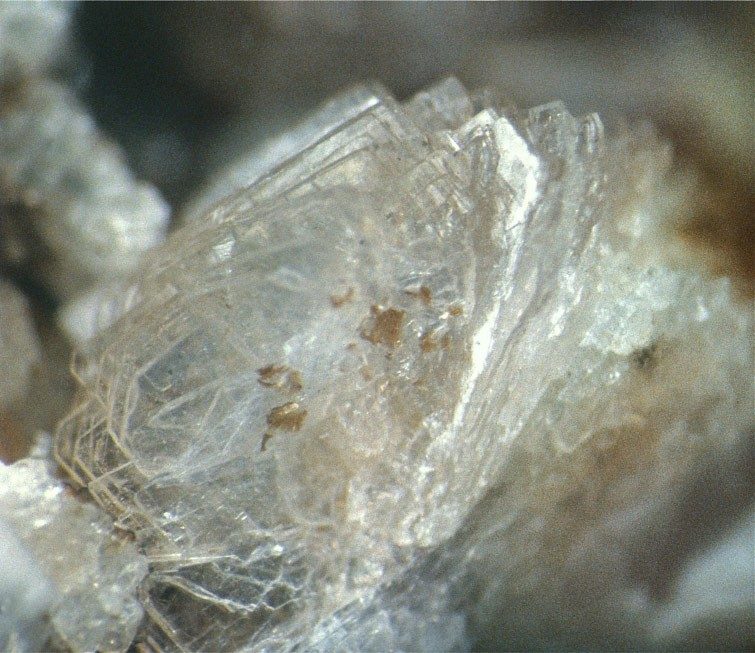
FOV 4.7 x 4.0 mm. Via Jean-Pierre Beckerich. Formerly MOB coll. This specimen was extensively studied (as MSH UK110) at Laurentian University. It is now in the collection at ROM. This is an old single focus film photo taken before the analysis commenced. This material was found in the vicinity of the Poudrette pegmatite but I'm not sure exactly where. The matrix looks more like the contact zone (aplite) or a "tributary" vein in hornfels than pegmatite proper. The tumchaite is associated with abundant gaidonnayite and JP sold it to me as a gaidonnayite specimen. When I couldn't identify the platy stuff I sent it off to Dr. AMcD. He was working on the characterization when he found that it was already proposed as IMA1999-10 from Vuoriyarvi. — Photo: Modris Baum · CC0
Tumchaite
A colorless sodium-zirconium phyllosilicate of carbonatites.
Intro adapted from Wikipedia (CC BY-SA).
Tumchaite is an IMA-recognized mineral species in the silicate class, with the chemical formula Na₂ZrSi₄O₁₁·2H₂O.
It crystallizes in the monoclinic crystal system (space group P2_1/c).
Key properties: Mohs hardness 4.5; specific gravity 2.78; White streak; Vitreous luster; optically biaxial.
IMA symbol Tum, IMA status: approved, named in 1999.
Found as a lens-like segregation in a core sample from a bore hole, which crosscuts veined dolomite-calcite carbonatites found in pyroxenites. Formed by hydrothermal alteration of carbonatite.
It is found associated with Calcite, dolomite, a mineral of the serpentine group, pyrite.
The name refers to the Tumcha river near the Vuoriyarvi massif.