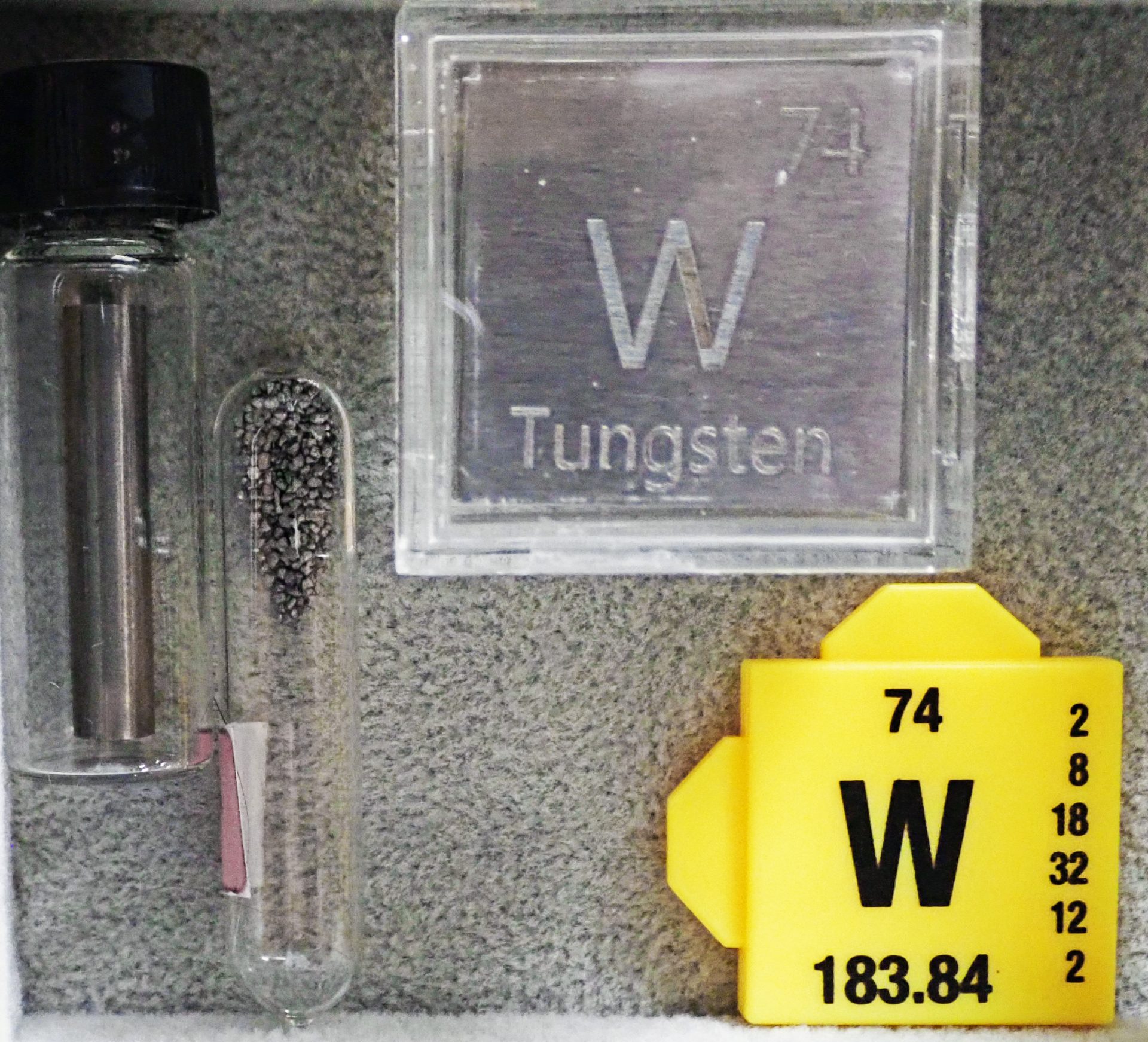
Tungsten (W) is # 74 on the Periodic Table of Elements. Elemental tungsten is a silvery-gray metal. It occurs in minerals having WO4 -2 anions, the tungstates (e.g., scheelite - CaWO4, calcium tungstate). Thirty-seven isotopes of tungsten are known - five occur naturally. Tungsten-184, tungsten-186, and tungsten-182 are the most common varieties. Tungsten-180 and tungsten-183 occur in lesser to small amounts. Info. at: en.wikipedia.org/wiki/Tungsten and en.wikipedia.org/wiki/Isotopes_of_tungsten and www.flickr.com/photos/jsjgeology/albums/72157677114792531/ — Photo: James St. John · CC BY 2.0
Tungsten
The densest hard metal (symbol W — wolfram — atomic number 74) — almost never native, occurring as wolframite and scheelite.
Intro adapted from Wikipedia (CC BY-SA).
Tungsten is an IMA-recognized mineral species in the native element class, with the chemical formula W.
It crystallizes in the cubic crystal system (space group Im3m). It is a member of the Iron structural group.
Key properties: Mohs hardness 7.5; specific gravity 19.226; Gray streak; Metallic luster.
IMA symbol W, IMA status: approved, named in 2011.
From gold placers in a river valley and in heavy concentrates from crushed quartz.
It is found associated with Yttriaite-(Y), quartz, ‘phengite’, siderite (Bol’shaya Pol’ya river valley).
The name comes from tung sten for ‘heavy stone’ in Swedish.