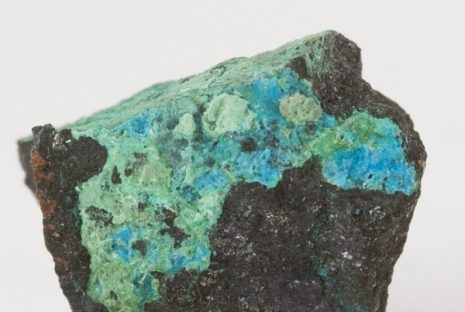
Tyrrellite , Chalcomenite , Umangite Locality: Eagle Claims U-Cu-Se occurrence (Hal Lake occurrence), Beaverlodge Lake area, Saskatchewan, Canada Size: 1.4 cm x 1.1 cm x 0.6 cm Tyrrellite is a very rare Cu-Co-Ni selenide and this colorful combination selenide thumbnail is from the obscure Co-type Locality. Specimens from here are rare and are very seldom available. Small patches of bronze-colored tyrrellite are noted on both sides of the matrix along with much bright blue chalcomenite and scattered grains of bluish red-black umangite. Fine and rare combination material from the Art Soregaroli Collection — Photo: Robert M. Lavinsky · CC BY-SA 3.0
Tyrrellite
A copper-cobalt-nickel selenide from Saskatchewan's Goldfields district and Czech deposits.
Intro adapted from Wikipedia (CC BY-SA).
Tyrrellite is an IMA-recognized mineral species in the sulfide class, with the chemical formula Cu(Co,Ni)₂Se₄.
It crystallizes in the cubic crystal system (space group Fd3m). It is a member of the Spinel structural group.
Key properties: Mohs hardness 3.5; specific gravity 6.6; Black streak; Metallic. R: (400) 41.8, (420) 42.6, (440) 43.5, (460) 44.4, (480) 45.0, (500) 45.5, (520) 45.9, (540) 46.3 luster.
IMA symbol Ty, grandfathered status — known before the IMA’s founding, named in 1952.
With other selenides, as the youngest hydrothermal replacements and open space fillings in sheared Precambrian rocks, which also contain uraninite deposits (Goldfields district, Canada).
It is found associated with Umangite, klockmannite, clausthalite, pyrite, hematite, chalcopyrite, chalcomenite (Ato Bay, Canada); berzelianite, eucairite, crookesite, ferroselite.
The mineral was named to honor Joseph Burr Tyrell (1858–1957), American geologist, first to visit the area of discovery in Canada.