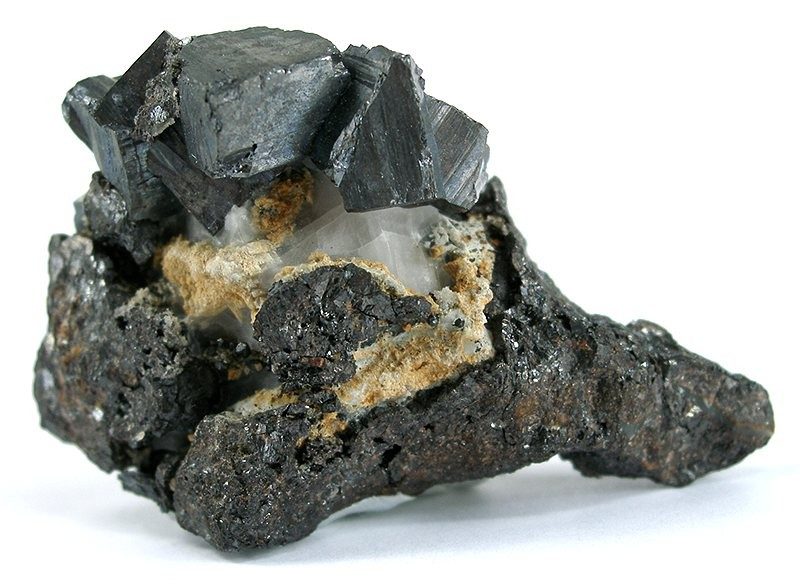
Ullmannite Locality: Masaloni Mine, San Vito , Cagliari Province , Sardinia , Italy ( Locality at mindat.org ) Size: 5.4 x 3.3 x 2.1 cm. This superb rarity features SHARP and LUSTROUS crystals to a full centimeter, perched up in a mound to make for a very attractive specimen of this usually not very attractive species. Sarrabus is a very important, ancient silver district. Ullmannites are one of those rare bystanders that so sadly, few were saved of. What is amazing about this specimen is that the piece actually has some display aesthetics whereas most are embedded in massive, ugly ore. From the collection of Gianguido Giannobi. — Photo: Robert M. Lavinsky · CC BY-SA 3.0
Ullmannite
Nickel-antimony sulfide — 'nickel glance' — metallic gray cubic crystals with partial cobalt substitution.
Intro adapted from Wikipedia (CC BY-SA).
Ullmannite is an IMA-recognized mineral species in the sulfosalt class, with the chemical formula NiSbS.
It crystallizes in the cubic crystal system (space group P2_13). It is a member of the Ullmannite structural group.
Key properties: Mohs hardness 5–5.5; specific gravity 6.65; Grayish black streak; Metallic. Anisotropism: Individuals may be weakly anisotropic revealing a fine lamellar structure. R: (400) 52.0 luster.
IMA symbol Ull, grandfathered status — known before the IMA’s founding, named in 1843.
With nickel minerals in hydrothermal veins.
It is found associated with Nickeline, gersdorffite, pentlandite, chalcopyrite, pyrrhotite, galena, tetrahedrite, dyscrasite.
In honor of Johan Christoph Ullmann (1771–1821), German chemist and mineralogist, who first discovered the mineral.