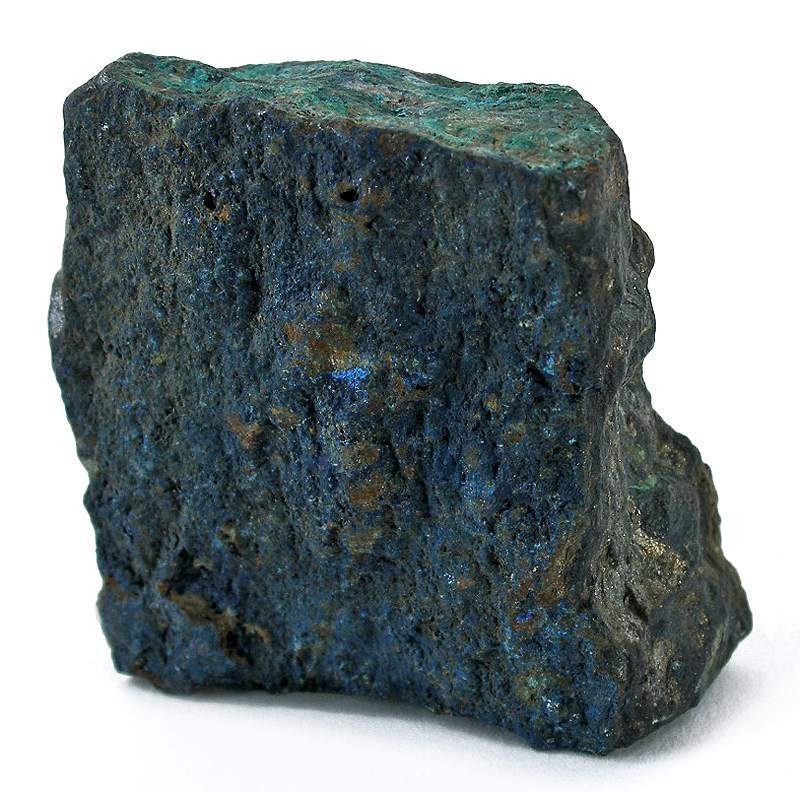
Umangite , Clausthalite Locality: Sierra de Cacheuta, Mendoza , Argentina ( Locality at mindat.org ) Size: 4.2 x 3.8 x 1.3 cm. There is a lot more than clausthalite in here. I am told that if you have purple (and you do, visible, here), you have umangite; and it’s a good bet there is klockmannite as well, and potentially all kinds of other good things. This specimen also contains Copper selenides because of the green secondaries. The non-metallic blue on there is likely chalcomenite, in fact. These specimens were presented to the academy by Casimiro Domeyko, who did much work on the rare minerals of Chile and Argentina. Ex. Academy of Natural Sciences Philadelphia Collection. — Photo: Robert M. Lavinsky · CC BY-SA 3.0
Umangite
A copper selenide forming small dark grains with other copper sulfides.
Intro adapted from Wikipedia (CC BY-SA).
Umangite is an IMA-recognized mineral species in the sulfide class, with the chemical formula Cu₃Se₂.
It crystallizes in the tetragonal crystal system (space group P-42_1m).
Key properties: Mohs hardness 3; specific gravity 6.44–6.49; Black streak.
IMA symbol Um, grandfathered status — known before the IMA’s founding, named in 1891.
With other selenides in hydrothermal veins, formed below 112 ° C.
It is found associated with Clausthalite, tiemannite, berzelianite, guanajuatite, eucairite, klockmannite, hessite, naumannite, chalcomenite, chalcopyrite, cobaltite, pyrite, malachite.
The name refers to the Sierra de Umango, Argentina, place of first discovery.