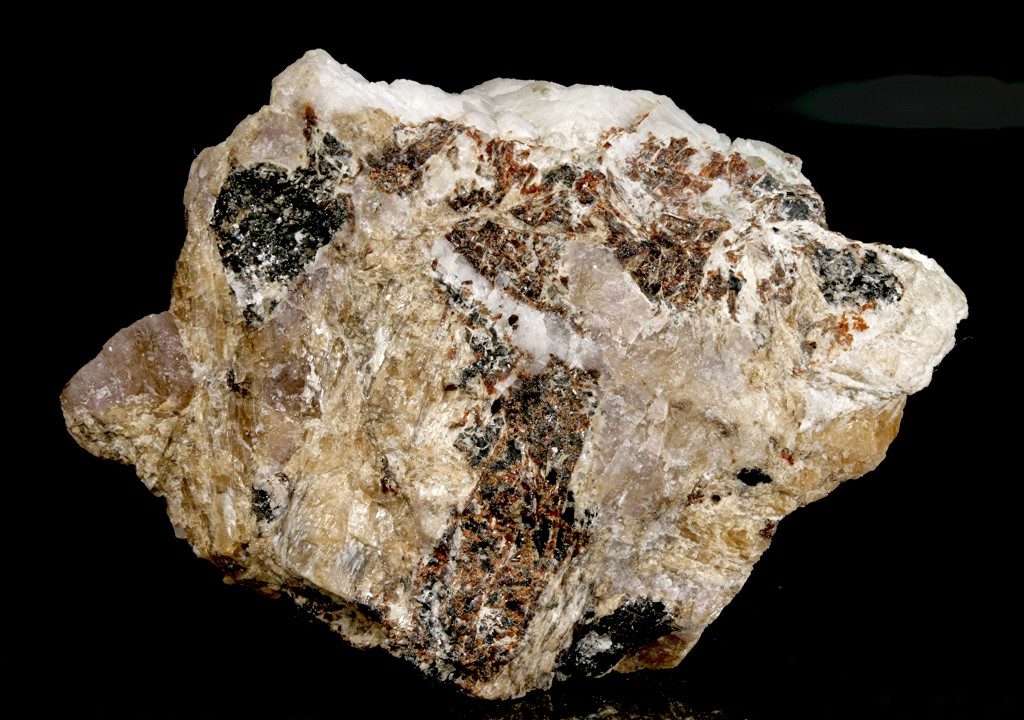
Belovite-(Ce) , Umbozerite , Sérandite , Shkatulkalite (FOV 7.1 x 4.7 mm) Locality: Shkatulka pegmatite, Umbozero mine (Umbozerskii mine; Umba Mine), Alluaiv Mt, Lovozero Massif, Murmanskaya Oblast', Northern Region, Russia Description: Thanks to Pavel Kartashov. MOB coll. This is part of [1] - which see for a complete list of minerals on the specimen and links to other close-ups. Orange sérandite (on the left), pink ussingite (top), greenish belovite-(Ce) (center). I see deep REE absorption lines. It’s a bit hard to tell exactly where they are coming from, but I’m fairly sure it is from the greenish xl. Per Pavel's inspection of the photo, he agrees that it is belovite. The xl is about 1¾ mm long. There is another, larger belovite xl on the specimen that Pavel pointed out (see the link above), but I failed to spot it because under tungsten lighting it looks too similar to sérandite. However, under CFL it turns quite green and can be easily spotted in the hand held specimen. (Note: Belovite-(Ce) apparently has fairly good cleavage for an apatite group mineral, which is another reason that I failed to spot via the scope.) The black stuff (on the right) has a conchoidal fracture and looks a bit like steenstruoine-(Ce, but is is altered umbozerite (as confirmed by Pavel from inspection of the photo.) The white stuff on the umbozerite is probably shkatulkalite. (Pavel did not comment on this.) Modified by CombineZP — Photo: Modris Baum · Public domain
Umbozerite
Umbozerite is an IMA-recognized mineral species in the silicate class, with the chemical formula Na₃Sr₄ThSi₈(O,OH)₂₄.
Key properties: Mohs hardness 5; specific gravity 3.6; Vitreous luster.
IMA symbol Ubz, IMA status: approved, named in 1973.
Found in pneumatolytic-hydrothermal veins cutting alkalic rocks in the upper part of a differentiated alkalic massif.
It is found associated with Ussingite, sphalerite, belovite, manganoan pectolite, lorenzenite, niobium-bearing minerals of the lomonosovite group.
The name refers to Lake Umbozero, Kola Peninsula, Russia, near where the mineral was discovered.