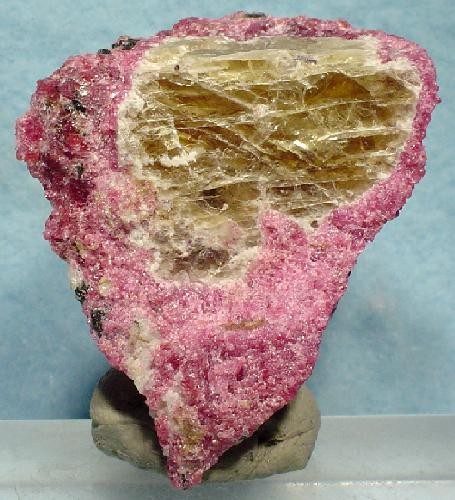
Vlasovite , Gittinsite , Eudialyte Locality: Kipawa alkaline complex, Les Lacs-du-Témiscamingue, Témiscamingue RCM, Abitibi-Témiscamingue , Québec , Canada ( Locality at mindat.org ) Size: 4.0 x 3.8 x 2.0 cm. A spectacular and showy specimen of a transparent yellow-gray vlasovite crystal frozen in bright pink eudialyte matrix. A white rind of gittinsite surrounds the vlasovite. Vlasovite and gittinsite are ULTRA-RARE zirconium silicates, found only in a few alkaline massifs worldwide. The Kipawa Complex is the Type Locality for gittinsite. This is a superb example. Vlasovite fluoresces a moderate yellow under UV illumination. Ex. Marty Zinn Collection. — Photo: Robert M. Lavinsky · CC BY-SA 3.0
Vlasovite
A rare sodium-zirconium chain silicate discovered in 1961 in the Kola Peninsula's Lovozero massif.
Intro adapted from Wikipedia (CC BY-SA).
Vlasovite is an IMA-recognized mineral species in the silicate class, with the chemical formula Na₂ZrSi₄O₁₁.
It crystallizes in the monoclinic crystal system (space group C2/c).
Key properties: Mohs hardness 6; specific gravity 2.92–2.97; Greasy; highly vitreous to pearly on cleavage surfaces luster; refractive index 1.619; optically biaxial.
IMA symbol Vsv, IMA status: approved, named in 1961.
A late phase in nepheline syenites, syenitic pegmatites, and along the contact zone of a differentiated alkalic massif (Lovozero massif, Russia); in miarolitic cavities in ejected blocks of peralkalic granite (Ascension Island).
It is found associated with Eudialyte, microcline, albite, lorenzenite, arfvedsonite, magnesio-katophorite, aegirine, aenigmatite, fayalite, pyrochlore, apatite, fluorite.
In honor of the Russian mineralogist and geochemist Kuz'ma Alekseevich Vlasov (1905–1964), founder of the Institute of Mineralogy, Geochemistry, and Crystal Chemistry of Rare Elements, Moscow, Russia.