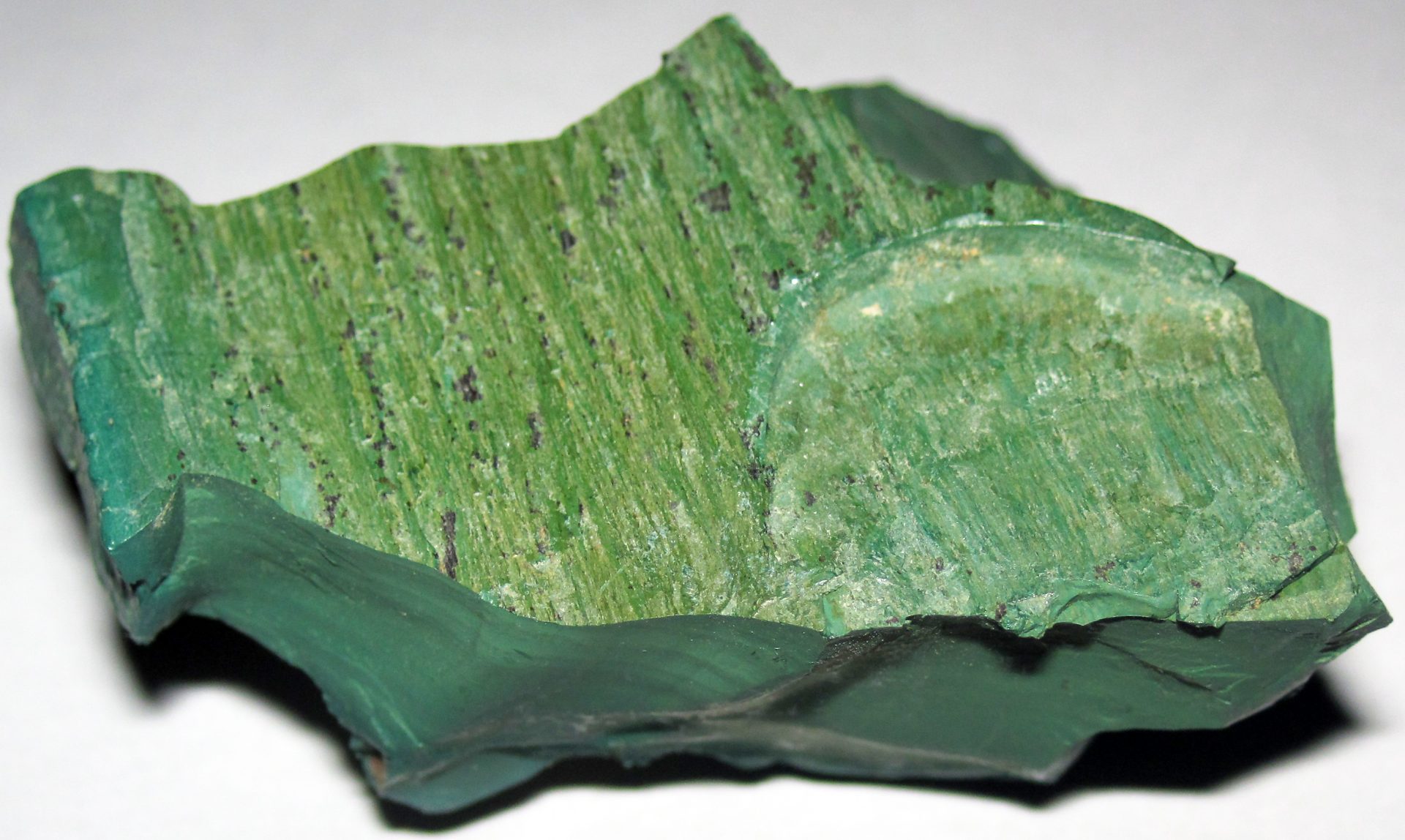
Volkonskoite-replaced fossil wood from the Permian of Russia. (4.3 cm across at its widest) This is a very rare specimen of fossil wood from Permian rocks in western Russia. Most fossil wood is preserved by quartz-permineralization or carbonization. This fossil wood has been replaced by a rare chromian smectite clay mineral called volkonskoite (Ca0.3(Cr,Mg,Fe)2(Si,Al)4O10 (OH)2⋅4H2O - hydrous calcium chromium magnesium iron hydroxy-aluminosilicate). The chromium (Cr) content gives the fossil its green coloration. The striations appear to be remnants of the original wood structure. The broken sides show that the massive, fine-grained volkonskoite breaks with a conchoidal fracture. Host rocks & age: soft fluvial sandstones, Kazanian to Tatarian Stages, upper Upper Permian Locality: Mt. Efimiatsk (Mt. Efimyatskaya), near the town of Efimyata, ~10 miles west of Votinsk Reservoir & ~30 miles southwest of Okhansk, Chastinsky District, southwestern Perm Region, western foothills of the southwestern Ural Mountains, western Russia — Photo: jsj1771 · CC BY 2.0
Volkonskoite
Volkonskoite is an IMA-recognized mineral species in the silicate class, with the chemical formula Ca₀.₃(Cr,Mg)₂(Si,Al)₄O₁₀(OH)₂·4H₂O.
It is a member of the Clay, Smectite-vermiculite structural group.
Key properties: Mohs hardness 1–2; specific gravity 2.11–2.36; Dull luster; optically biaxial.
IMA symbol Vkn, IMA status: approved, named in 1831.
An epigenetic mineral in sandstones, conglomerates, and red beds, commonly filling voids from the decomposition of organic matter (Okhansk region, Russia); a weathering product of serpentinite (Gotse Delchev, Bulgaria).
It is found associated with Chlorite, tridymite.
The name refers to Prince Petr Mikhailovich Volkonskii (1776–1852), Minister of the Imperial Court, Russia, patron of the natural sciences.