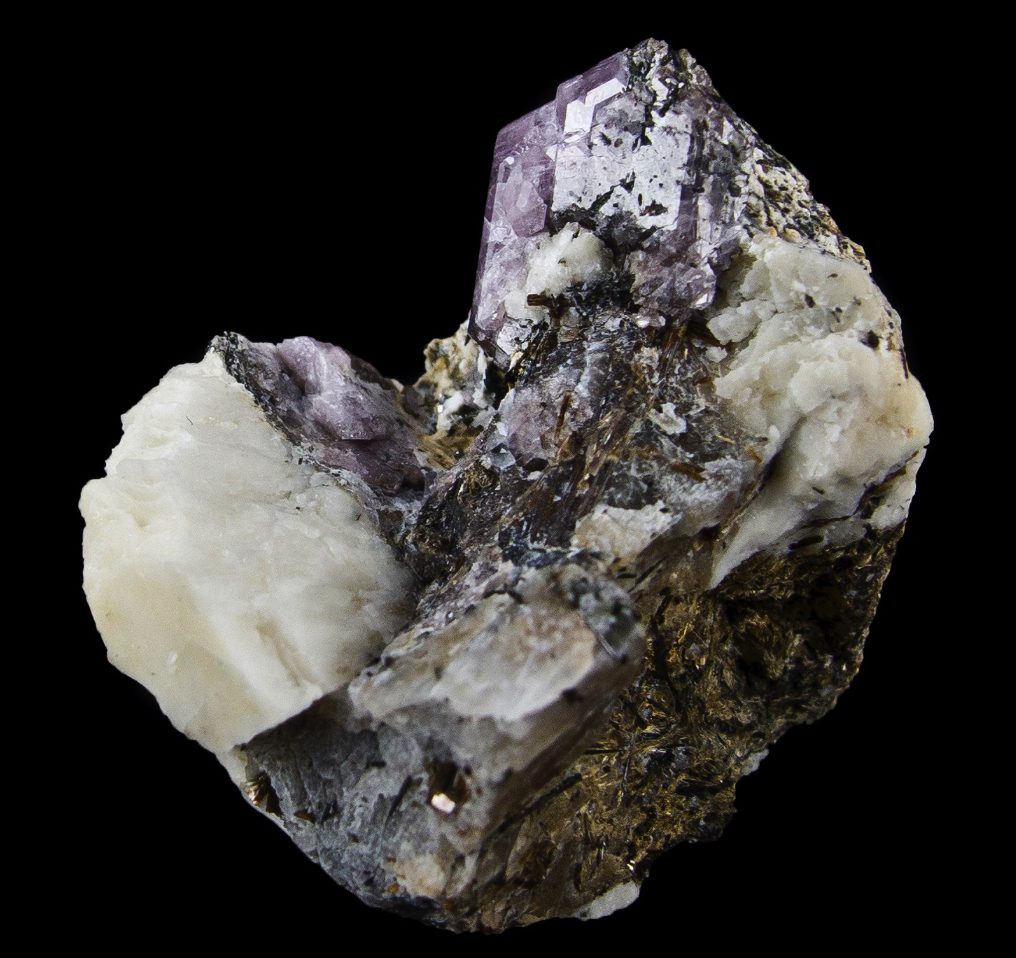
Wadeite Locality: Eveslogchorr Mt, Khibiny Massif, Murmansk Oblast, Russia Size: 2.7 x 2.7 x 2.2 cm A spectacular, near best-of-species specimen of wadeite consisting of a 1.8cm, tabular, hexagonal prism on an orthoclase-aegirine matrix. If the size and aesthetic positioning on the piece isn't enough, the crystal is a beautiful pale lavender color and resembles an apatite crystal in appearance. Wadeite is a very rare potassium zirconium silicate. Ex. Paul Stahl Collection, and obtained by him in the 1990s from the Fersman Museum deaccessions at a show in Munich. This is a significant specimen for this rare species that is quite aesthetic. The crystal is fully displayed perched atop matrix. — Photo: Robert M. Lavinsky · CC BY-SA 3.0
Wadeite
Wadeite is an IMA-recognized mineral species in the silicate class, with the chemical formula K₂ZrSi₃O₉.
It crystallizes in the hexagonal crystal system (space group P6_3/m).
Key properties: Mohs hardness 6–6.5; specific gravity 3.1–3.13; Adamantine luster; optically uniaxial.
IMA symbol Wad, grandfathered status — known before the IMA’s founding, named in 1939.
Found in veins in leucite lamproites (Wolgidee Hills, Western Australia); in nepheline-feldspathoid and natrolite veins in a differentiated alkalic massif (Khibiny massif, Russia).
It is found associated with Leucite, phlogopite, olivine, titanian potassian fluor-richterite, perovskite, apatite, calcite, barite, \chalcedony, " zeolites (West Kimberley area.
The name refers to Dr. Arthur Wade, Australian geologist who first collected the mineral.