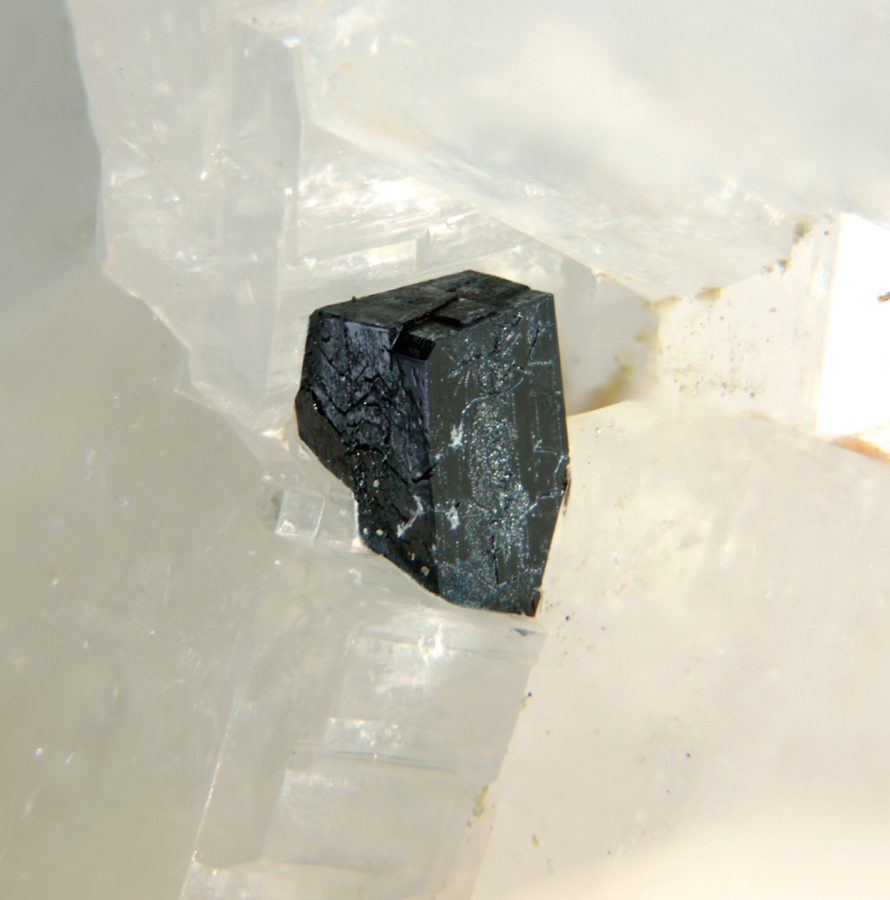
:Locality: Yellow Lake, Olalla, British Columbia, Canada Size: 3 × 1.6 × 1.4 cm Description: On a crystalline matrix of brewsterite-Sr, an unusual zeolite, we can observe a small wakefieldite-(Ce) well formed crystal. Rich in faces and defined edges. Deep black color, contrasting on the matrix. Wakefieldite-(Ce) is a extremely rare species, it is a cerium vanadate, with few La content. It is very curious the association of a REE vanadate with zeolite species. It comes from the analcime-phonolite flows exposed in road cuts of Highway 3A along the Yellow lake. — Photo: Joan Rosell , from rosellminerals.com · CC BY-SA 4.0
Wakefieldite-(Ce)
Wakefieldite-(Ce) (CeVO4) is the cerium analogue of the uncommon rare-earth element vanadate mineral Wakefieldite. It is a member of the xenotime group. Wakefieldite-(Ce) was first described in 1977. It was initially given the name kusuïte for its type locality in the Kusu deposit, 85 km (53 mi) SW of Kinshasa, Zaire. In 1987 it was renamed as the Ce analog of wakefieldite-Y.
Intro adapted from Wikipedia (CC BY-SA).
Wakefieldite-(Ce) is an IMA-recognized mineral species in the vanadate class, with the chemical formula CeVO₄.
It crystallizes in the tetragonal crystal system (space group I4_1/amd). It is a member of the Zircon structural group.
Key properties: Mohs hardness 4.5–5; specific gravity 4.74; Rust-brown streak; optically uniaxial.
IMA symbol Wf-Ce, IMA status: approved, named in 1969.
Found in silicified limestone (Kusu deposit, Congo); in vesicles with zeolites (Yellow Lake, Canada).
It is found associated with Mottramite (Kusu deposit, Congo); brewsterite, heulandite, analcime, mesolite, thomsonite, calcite, fluorite (Yellow Lake, Canada).
Originally described as “kusuite”; the name later changed to reflect its identity as the cerium analog of wakefieldite-(Y).