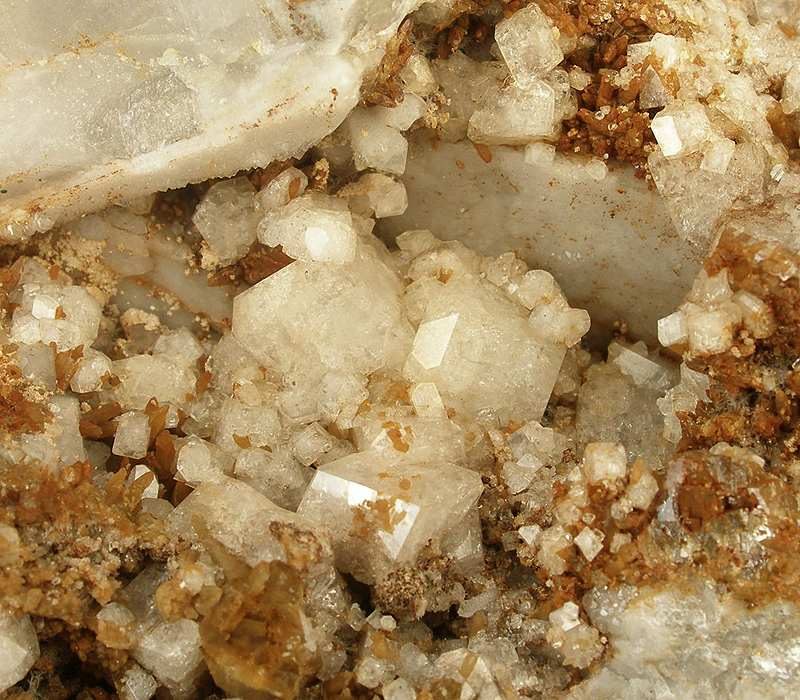
Whitlockite Locality: Palermo No. 1 Mine (Palermo #1 pegmatite), Groton , Grafton County , New Hampshire , USA ( Locality at mindat.org ) Size: large cabinet, 16 x 15 x 13 cm Whitlockite This huge specimen is probably the richest whitlockite specimen extent, for good quality, according to Whitmore and several people I consulted. He recovered it himself over 20 years ago from a small pocket in the mine he owns. It has great coverage and richness, but what really makes it notable are the huge, unusually well-developed crystals to nearly 1 centimeter. Most of the major crystals are clustered around one protected pocket, as well. Whitlockite is a very interesting species at the moment as some "whitlockites" have proven to be the new species Bobdownsite - this, however, is thought to remain a whitlockite. Pen shown for scale. Ex. Robert Whitmore Collection. — Photo: Robert M. Lavinsky · CC BY-SA 3.0
Whitlockite
An uncommon calcium phosphate — found in pegmatites, guano caves, meteorites and your teeth.
Intro adapted from Wikipedia (CC BY-SA).
Whitlockite is an IMA-recognized mineral species in the phosphate class, with the chemical formula Ca₉Mg(PO₃OH)(PO₄)₆.
It crystallizes in the hexagonal crystal system (space group R3c). It is a member of the Cerite structural group.
Key properties: Mohs hardness 5; specific gravity 3.12; Vitreous to subresinous luster; refractive index 1.628; optically uniaxial.
IMA symbol Wht, grandfathered status — known before the IMA’s founding, named in 1941.
Occurs as an uncommon secondary mineral in complex zoned granite pegmatites; in phosphate rock deposits; may be formed in caves from leached guano; in chondrite meteorites.
It is found associated with Ludlamite, fairfieldite, triphylite, siderite, apatite, quartz (pegmatites); hydroxylapatite (caves and islands); stanfieldite, farringtonite.
The mineral was named to honor Herbert Percy Whitlock (1868–1948), American mineralogist, Curator, American Museum of Natural History, New York City, New York, USA.