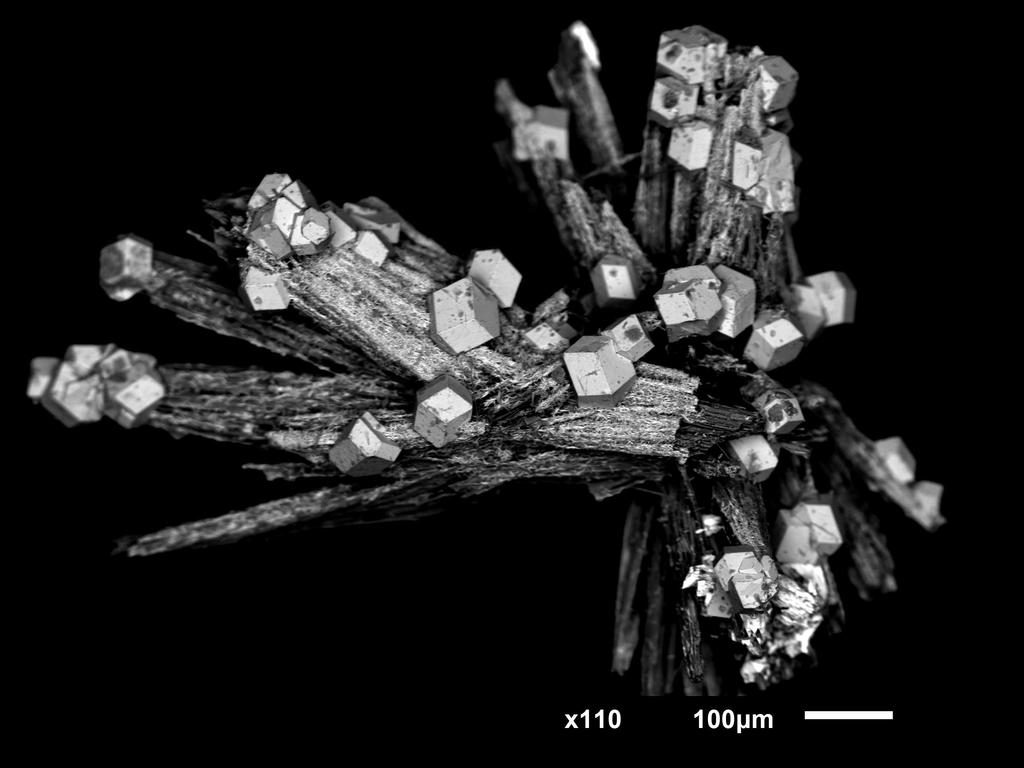
Group of moraesite crystals in association with wilancookite. From Ponte do Piauí claim, Piauí valley, Taquaral, Itinga, Jequitinhonha valley, Minas Gerais, Brazil. Sample in the archives of the Geology Department - Federal University of Ouro Preto. — Photo: Ricardo Scholz · CC0
Wilancookite
A very rare hydrated beryllium phosphate from a Brazilian pegmatite.
Intro adapted from Wikipedia (CC BY-SA).
Wilancookite is an IMA-recognized mineral species in the oxides & hydroxide class, with the chemical formula (Ba₅Li₂ )Ba₆Be₂₄P₂₄O₉₆·26H₂O.
It crystallizes in the cubic crystal system (space group I23).
Key properties: Mohs hardness 4–5; specific gravity 3.05; White streak; Vitreous luster.
IMA symbol Wck, IMA status: approved, named in 2015.
Found as a secondary mineral in phosphate nodules near the quartz core of a complex granitic pegmatite, developed during late stages by reaction between montebrasite and beryl.
It is found associated with Fluorapatite, childrenite, eosphorite, zanazziite, greifenstenite, guimarãesite, ushkovite, saléeite, moraesite, albite, montebrasite, Li-bearing micas.
The mineral was named to honor American mineralogist and crystallographer William R. Cook Jr. (1927-2006) and his wife Anne.