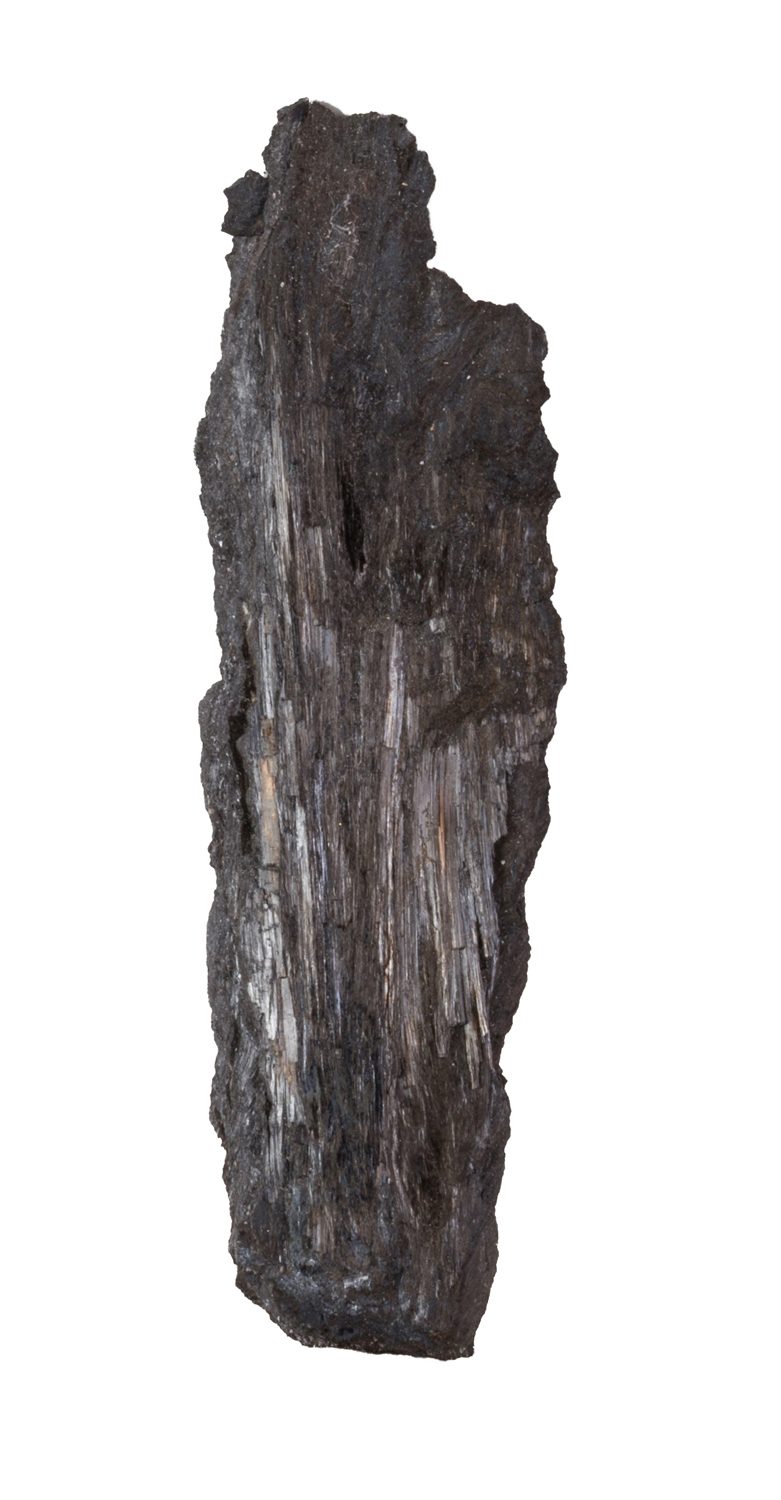
Wiserite Dimensions: 8.3 cm x 2.3 cm x 0.8 cm Locality: Gonzen Mine, Sargans, Alvier Group, St Gallen, Switzerland Wiserite is a very rare compound borate found in manganese ore deposits. This less well-known ancient Swiss Fe-Mn mine, abandoned in 1966, is the Type Locality. Specimens are rare. This is extremely rich solid small cabinet lathe of silky lustre, brownish-gray fibrous masses of the rarity. Ex Matioli Collection. — Photo: Robert M. Lavinsky · CC BY-SA 3.0
Wiserite
Wiserite is an IMA-recognized mineral species in the silicate class, with the chemical formula Mn²⁺₁₄(B₂O₅)₄(OH)₈·(Si,Mg)(O,OH)₄Cl.
It crystallizes in the tetragonal crystal system (space group P4/n).
Key properties: Mohs hardness 2.5; specific gravity 3.54; Vitreous luster; optically uniaxial.
IMA symbol Wis, grandfathered status — known before the IMA’s founding, named in 1845.
An accessory mineral in stratiform manganese deposits.
It is found associated with Hausmannite, jacobsite, alleghanyite, pyrochroite, pyrobelonite, calcite, rhodochrosite, jimboite, sussexite, alabandite, galaxite, tephroite, gageite.
The name refers to David Friedrich Wiser (1802–1878), Swiss mineralogist who first analyzed the mineral.