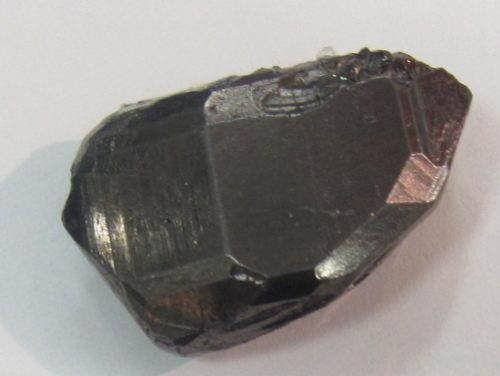
Wittichenite Locality: Cattlegrid pit (Cattlegrid mine), Mount Gunson, Stuart Shelf area, Andamooka Ranges - Lake Torrens area, South Australia, Australia Original description: A wittichenite crystal about 35mm long, in the Smithsonian Museum. — Photo: Ralph Bottrill · CC BY 3.0
Wittichenite
Wittichenite is an IMA-recognized mineral species in the sulfosalt class, with the chemical formula Cu₃BiS₃.
It crystallizes in the orthorhombic crystal system (space group P2_12_12_1).
Key properties: Mohs hardness 2–3; specific gravity 6.01; Black streak; Metallic. Anisotropism: Weak, shades of dark brown. R1 –R2: (400) 35.0–36.9, (420) 34.1–35.8, (440) 33.2–34.7 luster.
IMA symbol Wtc, grandfathered status — known before the IMA’s founding, named in 1853.
Found in hydrothermal veins with other bismuth minerals (Wittichen, Germany); with Cu-Fe sulfides (Seathwaite Tarn, England); with secondary uranium minerals and selenides of Cu, Pb, and Bi (Kletno, Poland).
It is found associated with Bornite, chalcocite, chalcopyrite, djurleite, digenite, tennantite, pyrite, stromeyerite, bismuth, emplectite, rammelsbergite, calcite, aragonite, fluorite.
The name commemorates the type locality, Wittichen, Germany.