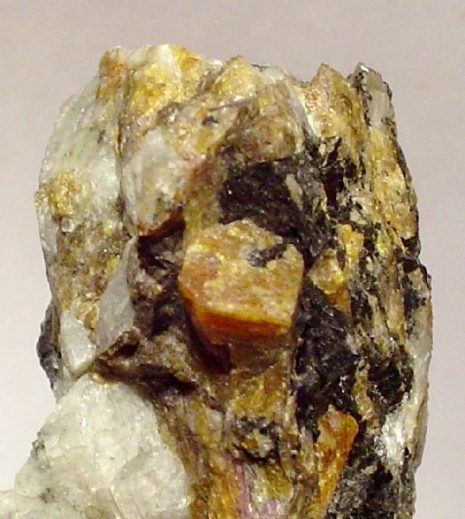
Wöhlerite Locality: Langesundsfjorden, Larvik, Vestfold, Norway Size: 6.2 cm x 3 cm x 2.6 cm Wöhlerite is a rare sodium, calcium, zirconium, niobium silicate found in the late phase of strange and uncommon alkalid pegmatites, nepheline syenites, fenites and carbonatites. This very rich old-time specimen is from near the famous Type Locality (discovered in 1843) in Norway, where thorite was discovered in 1829. Lustrous, translucent, yellowish-brown wohlerite crystals and crystal fragments to about 1.5 cm are richly scattered on all sides of the starkly contrasting, two-toned matrix. Rarely available from this locality. Accompanied by an expertly handwritten, faded label from an older collection. The collection this came out of was a museum stash dating to prior to World War I. — Photo: Robert M. Lavinsky · CC BY-SA 3.0
Wöhlerite
A sodium-calcium zirconium-niobium sorosilicate named for chemist Friedrich Wöhler.
Intro adapted from Wikipedia (CC BY-SA).
Wöhlerite is an IMA-recognized mineral species in the silicate class, with the chemical formula Na₂Ca₄Zr(Nb,Ti)(Si₂O₇)₂(O,F)₄.
It crystallizes in the monoclinic crystal system (space group P2_1). It is a member of the Wöhlerite structural group.
Key properties: Mohs hardness 6–6.5; specific gravity 3.4–3.44; Pale yellow streak; Vitreous, inclining to resinous, dull, and greasy luster; optically biaxial.
IMA symbol Wöh, grandfathered status — known before the IMA’s founding, named in 1843.
A late phase in alkalic pegmatites; an accessory mineral in nepheline syenites; in fenites in association with alkaline intrusives; and in carbonatites.
It is found associated with Cancrinite, ferro-hornblende, aegirine, astrophyllite, mosandrite, eudialyte, catapleiite, rosenbuschite, lº a venite, zircon, pyrochlore, betafite.
The name refers to Professor Friedrich WÄo hler (1800–1882), German chemist, GÄo ttingen, Germany.