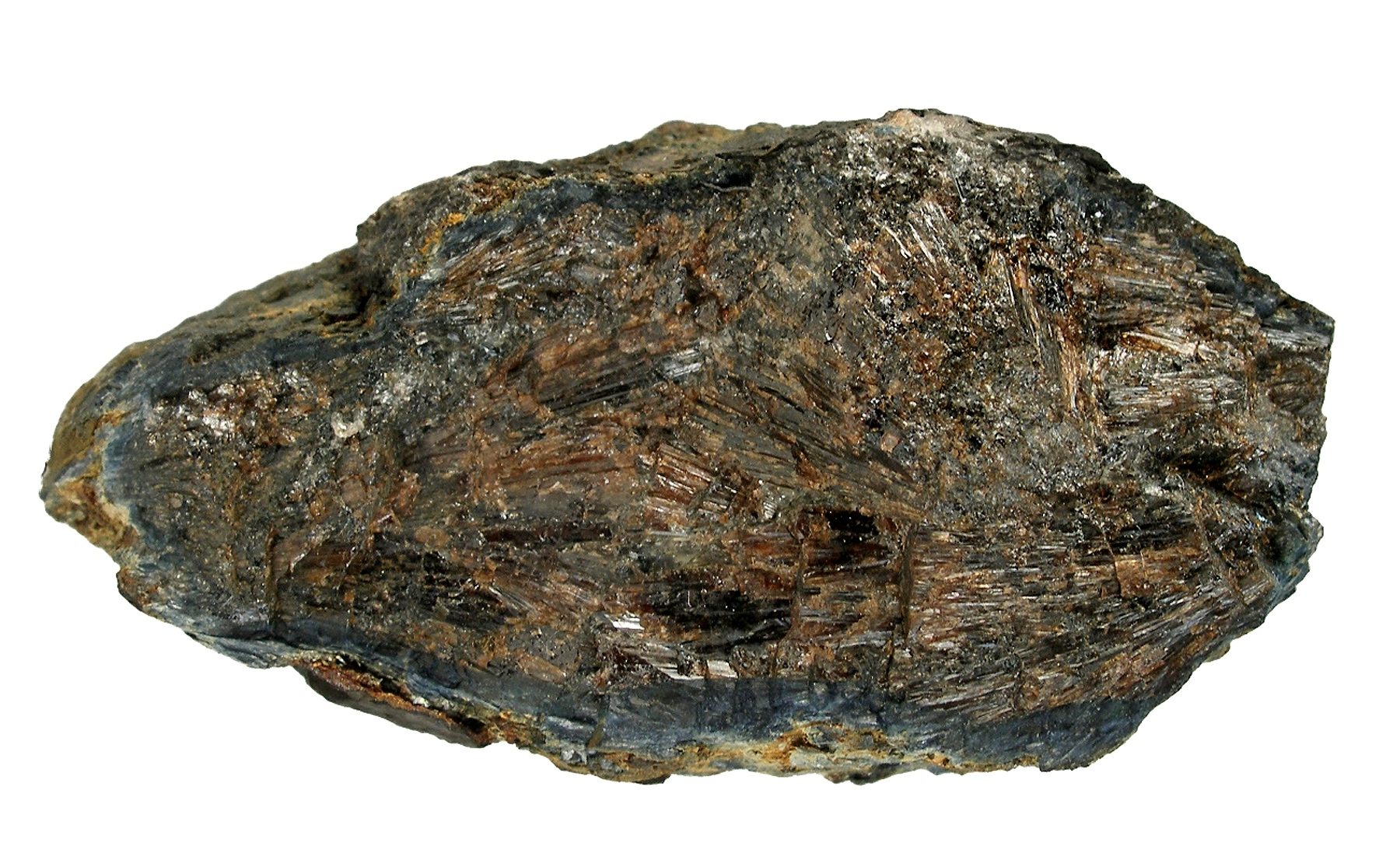
Wolfeite Locality: Big Fish River, Dawson Mining District, Yukon Territory, Canada ( Locality at mindat.org ) This is a very rich specimen of this rare phosphate, wolfeite, only seldom seen even at these rich phosphate localities in the remote Yukon (and near nonexistent from other places). It is a very rich, relatively showy example of this species. The phosphate deposits of the Yukon are one of the world's great sources of a suite of rare phosphate species, and the Ordway collection was known for them over the years. This particular piece shows extremely good crystals, in intergrown clusters in matrix It can easily be trimmed into several specimens of equal value . Self-collected by Al Ordway in the 1970s. 6.1 x 3.2 x 2.3 cm — Photo: Robert M. Lavinsky · CC BY-SA 3.0
Wolfeite
Wolfeite is an IMA-recognized mineral species in the phosphate class, with the chemical formula Fe²⁺₂(PO₄)(OH).
It crystallizes in the monoclinic crystal system (space group P2_1/a). It is a member of the Wagnerite structural group.
Key properties: Mohs hardness 4.5–5; specific gravity 3.79–3.82; Vitreous to silky if fibrous luster; optically biaxial.
IMA symbol Wol, grandfathered status — known before the IMA’s founding, named in 1949.
A secondary mineral, formed by hydrothermal alteration of triphylite in complex zoned granite pegmatites; rarely in hydrothermal veins; in phosphatic nodules in shales.
It is found associated with Triphylite, triplite, hagendorfite, arrojadite, apatite (pegmatites); wicksite, satterlyite, marićite (shales).
The mineral was named to honor Professor Caleb Wroe Wolfe (1908–1980), American crystallographer, Boston University, Boston, Massachusetts, USA.