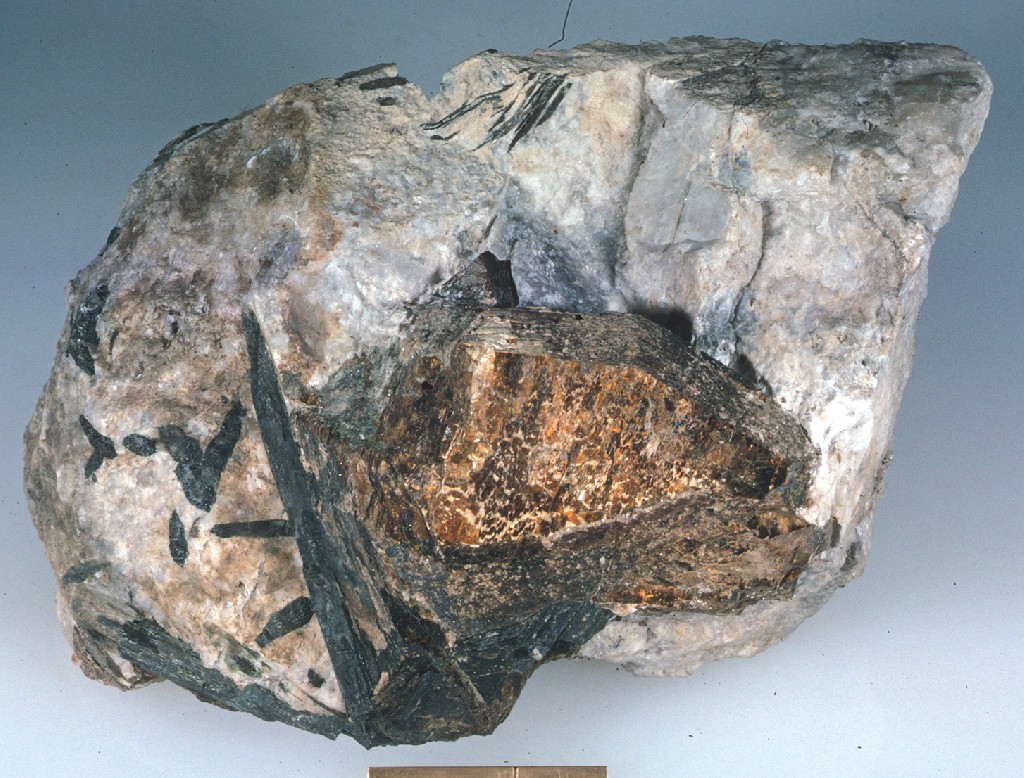
Astrophyllite, Aegirine Locality: Langesundsfjorden, Larvik, Vestfold, Norway Brown astrophyllite crystal in matrix with black prismatic aegirine. Specimen is i — Photo: Rock Currier · CC BY 3.0
Aegirine
Also known as: Acmite.
Aegirine is a mineral. It is a member of the clinopyroxene group of inosilicate minerals. Acmite is a fibrous green-colored variety of aegirine, with the name also used as a synonym. It was first described in 1821, in Kongsberg, Norway.
Intro adapted from Wikipedia (CC BY-SA).
Aegirine is an IMA-recognized mineral species in the silicate class, with the chemical formula NaFe³⁺Si₂O₆.
It crystallizes in the monoclinic crystal system (space group C2/c). It is a member of the Pyroxene structural group.
Key properties: Mohs hardness 6–6.5; specific gravity 3.5–3.6; typically green or black or brown; Pale yellowish gray streak; Vitreous to slightly resinous luster; refractive index 1.776; optically biaxial.
IMA symbol Aeg, IMA status: approved, named in 1835.
Common in alkalic igneous rocks, carbonatites, and pegmatites. From regionally metamorphosed schists, gneisses, and iron formations; in blueschist facies rocks, and from sodium metasomatism in granulites.
It is found associated with Potassic feldspar, nepheline, riebeckite, arfvedsonite, aenigmatite, astrophyllite, catapleiite, eudialyte, s¶erandite, apophyllite.
The name comes from Àgir, the Scandinavian sea-god, as first described from Norway.
Collections: Collector Favorites.