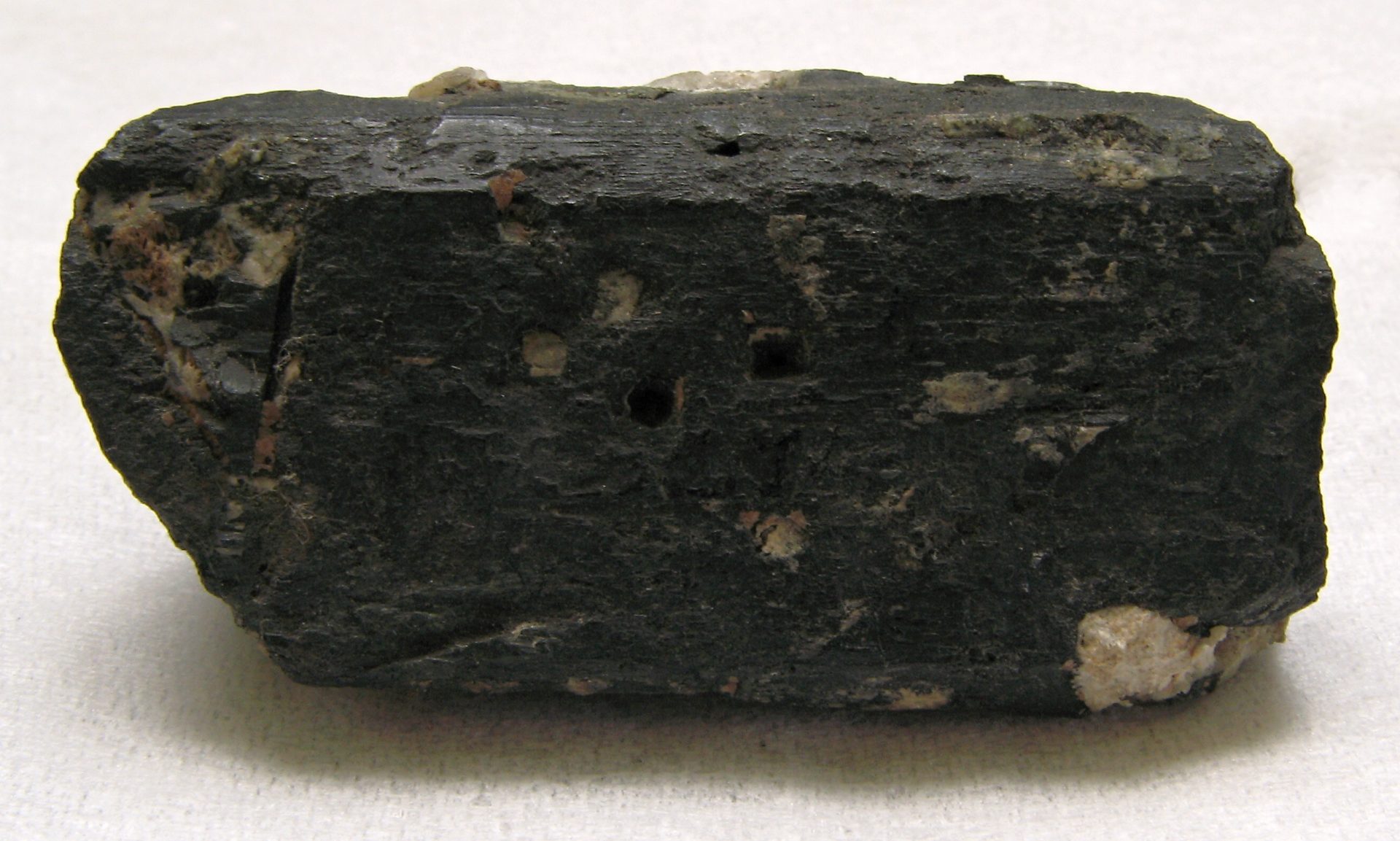
Aenigmatite Locality: from the sodalite-syenite of Kangerdluarsuk (Kangerdluarssuq), Greenland Exposed in the Mineralogical Museum of University Bonn, Germany — Photo: Ra'ike · CC BY-SA 3.0
Aenigmatite
Aenigmatite, also known as cossyrite after Cossyra, the ancient name of Pantelleria, is a sodium, iron, titanium inosilicate mineral. The chemical formula is Na2Fe2+5TiSi6O20 and its structure consists of single tetrahedral chains with a repeat unit of four and complex side branches. It forms brown to black triclinic lamellar crystals. It has Mohs hardness of 5.5 to 6 and specific gravity of 3.74 to 3.85. Aenigmatite forms a solid-solution series with wilkinsonite, Na2Fe2+4Fe3+2Si6O20.
Intro adapted from Wikipedia (CC BY-SA).
Aenigmatite is an IMA-recognized mineral species in the silicate class, with the chemical formula Na₄[Fe²⁺₁₀Ti₂]O₄[Si₁₂O₃₆].
It crystallizes in the triclinic crystal system (space group P-1). It is a member of the Sapphirine structural group.
Key properties: Mohs hardness 5.5; specific gravity 3.81; Reddish brown streak; Vitreous to greasy luster; refractive index 1.829; optically biaxial.
IMA symbol Aen, IMA status: approved, named in 1865.
A primary constituent in sodium-rich alkalic volcanics, pegmatites, and other silica-poor igneous rocks.
It is found associated with Aegirine, augite, riebeckite, arfvedsonite, hedenbergite, fayalite, ilmenite.
Its name comes from the Greek for riddle, apparently an allusion to its (formerly) uncertain chemical composition.