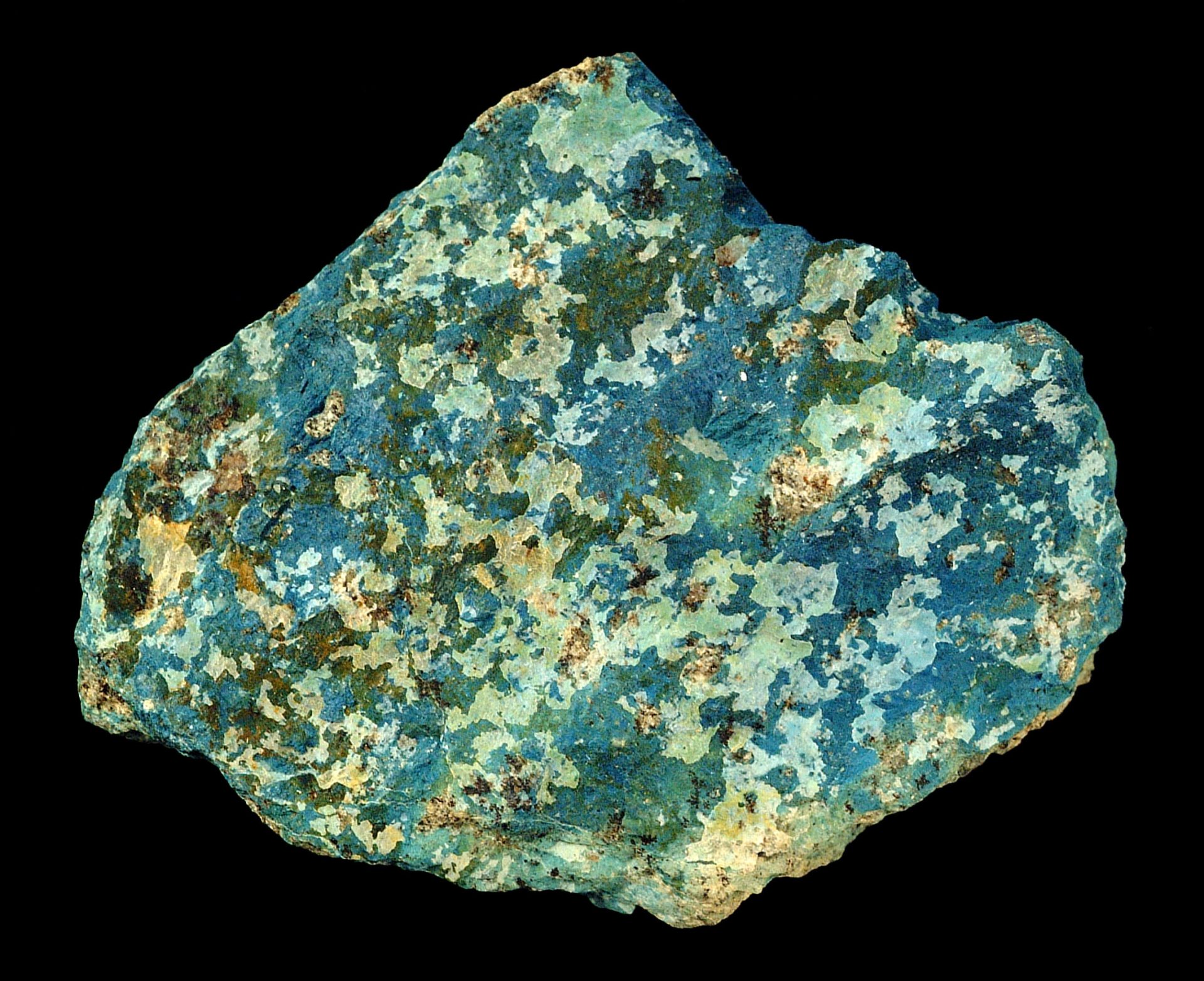
The blue mineral is aerinite, a secondary mineral that forms as an alteration product in mafic-intermediate volcanic rocks. It is a chain silicate that shares properties with both amphiboles and zeolites, and has formula of about (Ca,Na)4Mg3(Fe,Al)3[(Si,Al)18O42](OH)6·11.5(H2O). This sample is about 5 cm across. — Photo: Darla Sondrol · CC0
Aerinite
Aerinite (Ca4(Al,Fe,Mg)10Si12O35(OH)12CO3·12H2O) is a bluish-purple inosilicate mineral. It crystallizes in the monoclinic system and occurs as fibrous or compact masses and coatings. It has a dark, vitreous luster, a specific gravity of 2.48 and a Mohs hardness of 3. It is a low-temperature hydrothermal phase occurring in zeolite facies alteration of dolerites. Associated minerals include prehnite, scolecite and mesolite. Its name comes from a Greek root "aerinos," meaning "atmosphere" or "sky blue".
Intro adapted from Wikipedia (CC BY-SA).
Aerinite is an IMA-recognized mineral species in the silicate class, with the chemical formula (Ca,Na)₆(Fe³⁺,Fe²⁺,Mg,Al)₄(Al,Mg)₆Si₁₂O₃₆(OH)₁₂(CO₃)·12H₂O.
It crystallizes in the hexagonal crystal system (space group P3c1).
Key properties: Mohs hardness 3; specific gravity 2.48; refractive index 3.383; optically biaxial.
IMA symbol Aer, IMA status: approved, named in 1876.
A hydrothermal mineral of the zeolite facies, formed at relatively low temperature, in fractures cutting mafic igneous rocks (Saint-Pandelon, France).
It is found associated with Prehnite, scolecite, mesolite (Saint-Pandelon, France).
Its name comes from the Greek for sky blue for its distinctive color.