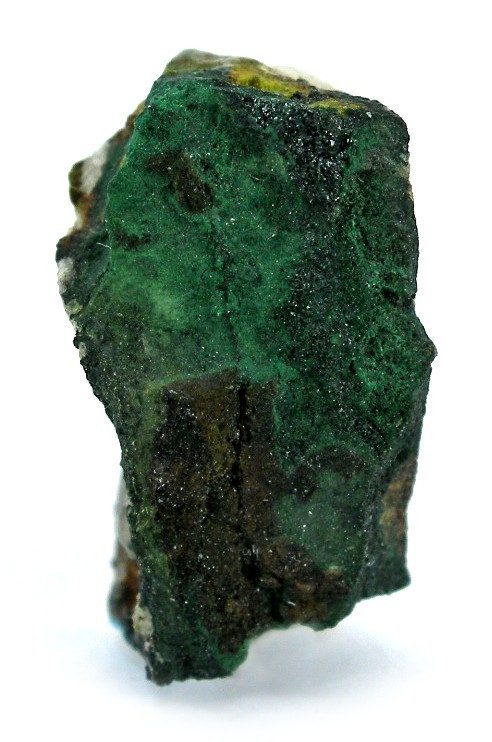
Aerugite Locality: Johanngeorgenstadt , Johanngeorgenstadt District, Erzgebirge , Saxony , Germany ( Locality at mindat.org ) Size: 1.7 x 0.9 x 0.8 cm The aerugite is both the lighter green and darker green material that's visible on the top face (confirmed by Dr. Mark Feinglos). The greenish yellow mineral is xanthiosite. I am told (though there is no way to prove it now), as it was in the American Museum by the late 1800s with catalogue number 5305 there. From the rarities suite of Lawrence Conklin, who exchanged it from the American Museum of Natural History. — Photo: Robert M. Lavinsky · CC BY-SA 3.0
Aerugite
Aerugite is a rare complex nickel arsenate mineral with a variably reported formula: Ni9(AsO4)2AsO6. It forms green to deep blue-green trigonal crystals. It has a Mohs hardness of 4 and a specific gravity of 5.85 to 5.95. It was first described in 1858 in either the South Terres mine of Cornwall, England or in the Ore Mountains, Saxony, Germany. The origin is disputed. The most common occurrence is as an incrustation on furnace walls in which ores are roasted. Its name comes from the Latin word aerugo for copper rust.
Intro adapted from Wikipedia (CC BY-SA).
Aerugite is an IMA-recognized mineral species in the arsenate class, with the chemical formula Ni₈.₅(AsO₄)₂As⁵⁺O₈.
It crystallizes in the hexagonal crystal system (space group R-3m).
Key properties: Mohs hardness 4; specific gravity 5.85; Pale green, pale blue-green streak.
IMA symbol Aru, IMA status: approved, named in 1858.
Found as a rare secondary mineral in hydrothermal Ni–As–U ore deposits.
It is found associated with Bismuth, bunsenite, xanthiosite (Johanngeorgenstadt, Germany); xanthiosite (South Terras mine, Cornwall, England).
Its name comes from the Greek for copper rust, an allusion to its appearance.