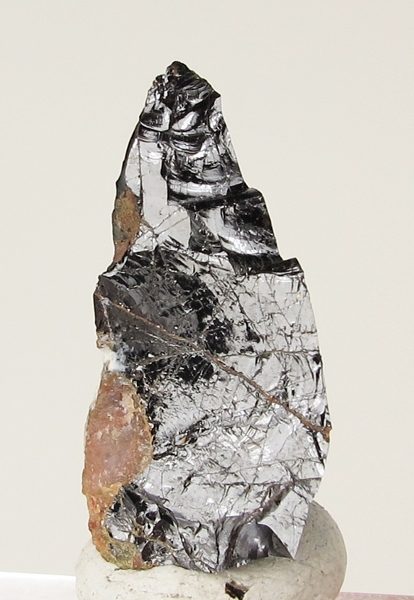
Aeschynite-(Y) Locality: Urstad feldspar quarry, Hidra (Hitterø), Flekkefjord, Vest-Agder, Norway ( Locality at mindat.org ) Size: 2.7 x 2.1 x 1.3 cm Aeschynite-(Y) is a rare, rare-earth species with yttrium as the dominant rare-earth element. This extremely rich piece is from the Type Locality in Norway. Splendent, waxy-lustre, deep brown to nearly black aeschynite-(Y) composes nearly the entire piece, with only a bit of matrix. The specimen looks like obsidian with the conchoidal fracturing, but its not. Ex. Josef Vajdak Collection. — Photo: Robert M. Lavinsky · CC BY-SA 3.0
Aeschynite-(Y)
Aeschynite-(Y) (or Aeschinite-(Y), Aeschynite-(Yt), Blomstrandine, Priorite) is a rare earth mineral of yttrium, calcium, iron, thorium, titanium, niobium, oxygen, and hydrogen with the chemical formula (Y,Ca,Fe,Th)(Ti,Nb)2(O,OH)6. Its name comes from the Greek word for "shame". Its Mohs scale rating is 5 to 6.
Intro adapted from Wikipedia (CC BY-SA).
Aeschynite-(Y) is an IMA-recognized mineral species in the oxides & hydroxide class, with the chemical formula (Y,Ln,Ca,Th)(Ti,Nb)₂(O,OH)₆.
It crystallizes in the orthorhombic crystal system (space group Pnma). It is a member of the Aeschynite structural group.
Key properties: Mohs hardness 5–6; specific gravity 4.82–4.93; White, pale yellow, reddish yellow streak; Submetallic to pearly on crystal faces, resinous to waxy on fracture surfaces luster; optically biaxial.
IMA symbol Aes-Y, IMA status: approved, named in 1906.
Found in granite and granite pegmatites; in ankerite-dolomitic carbonatites; as a detrital mineral in placers.
It is found associated with Euxenite, monazite, xenotime, allanite, zircon, fergusonite, thorite, synchysite, gadolinite, chernovite, columbite, biotite, muscovite, titanite, corundum.
The name refers to similarity to aeschynite-(Ce), with yttrium as the dominant rare-earth element.