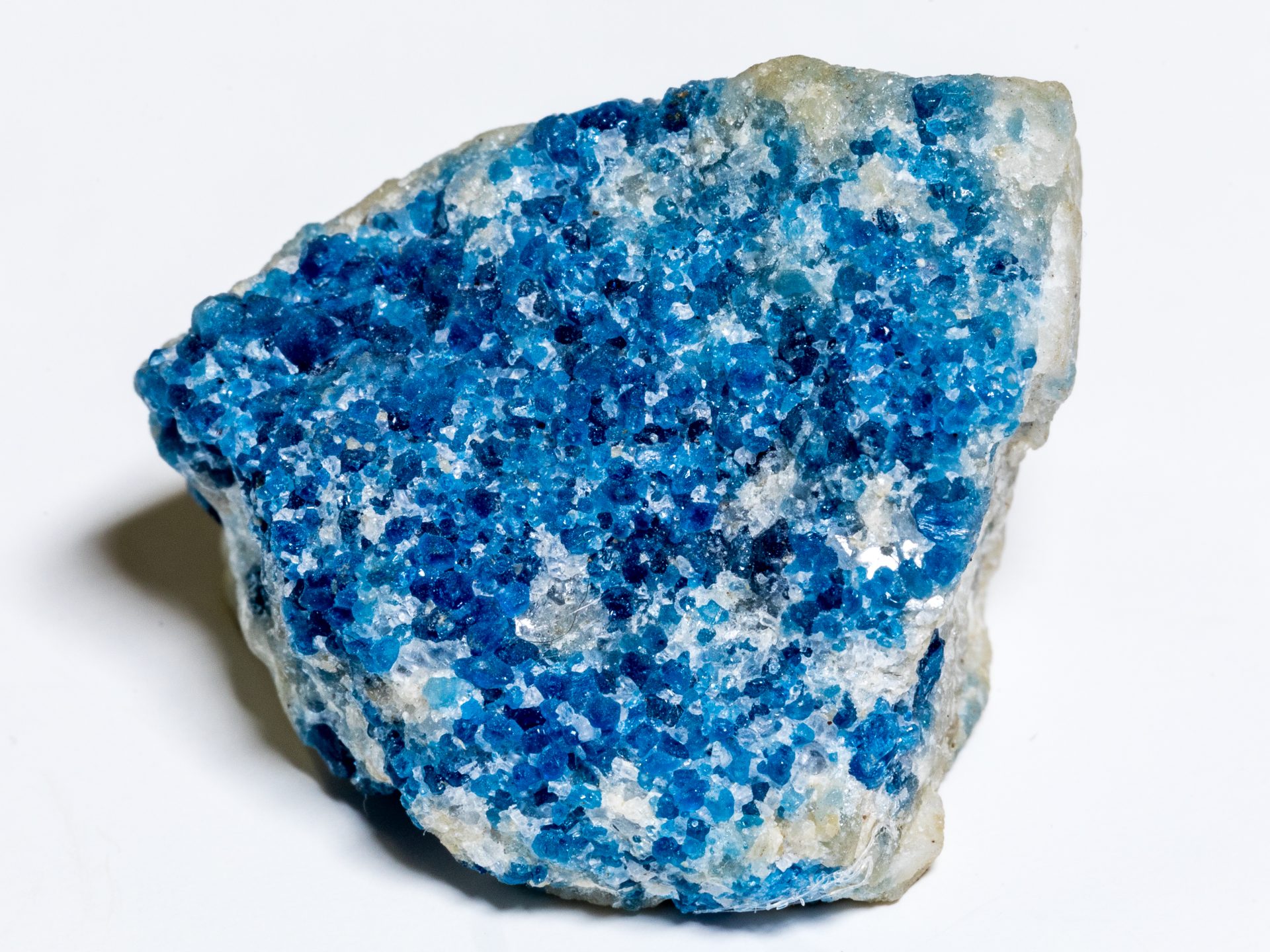
Afghanite (Weight: 9.6 g) – Place of discovery: Sar-e-Sang, Badakshan, Afghanistan — Photo: Raimond Spekking · CC BY-SA 4.0
Afghanite
Afghanite, (Na,K)22Ca10[Si24Al24O96](SO4)6Cl6, is a hydrous sodium, calcium, potassium, sulfate, chloride, carbonate alumino-silicate mineral. Afghanite is a feldspathoid of the cancrinite group and typically occurs with sodalite group minerals. It forms blue to colorless, typically massive crystals in the trigonal crystal system. The lowering of the symmetry from typical (for cancrinite group) hexagonal one is due to ordering of Si and Al. It has a Mohs hardness of 5.5 to 6 and a specific gravity of 2.55 to 2.65. It has refractive index values of nω = 1.523 and nε = 1.529.
Intro adapted from Wikipedia (CC BY-SA).
Afghanite is an IMA-recognized mineral species in the silicate class, with the chemical formula (Na,K)₂₂Ca₁₀(Si₂₄Al₂₄)O₉₆(SO₄)₆Cl₆.
It crystallizes in the hexagonal crystal system (space group P31c). It is a member of the Cancrinite-sodalite structural group.
Key properties: Mohs hardness 5.5–6; specific gravity 2.55; Vitreous luster; refractive index 1.526; optically uniaxial.
IMA symbol Afg, IMA status: approved, named in 1967.
Found in thin veinlets cutting lazurite crystals (Sar-e-Sang, Afghanistan); in silicified limestone xenoliths in pumice (Pitigliano quarry, Italy).
It is found associated with Lazurite, sodalite, nepheline, phlogopite, olivine, diopside, vesuvianite, calcite, pyrite.
The name refers to the country of first occurrence, AFGHANistan.