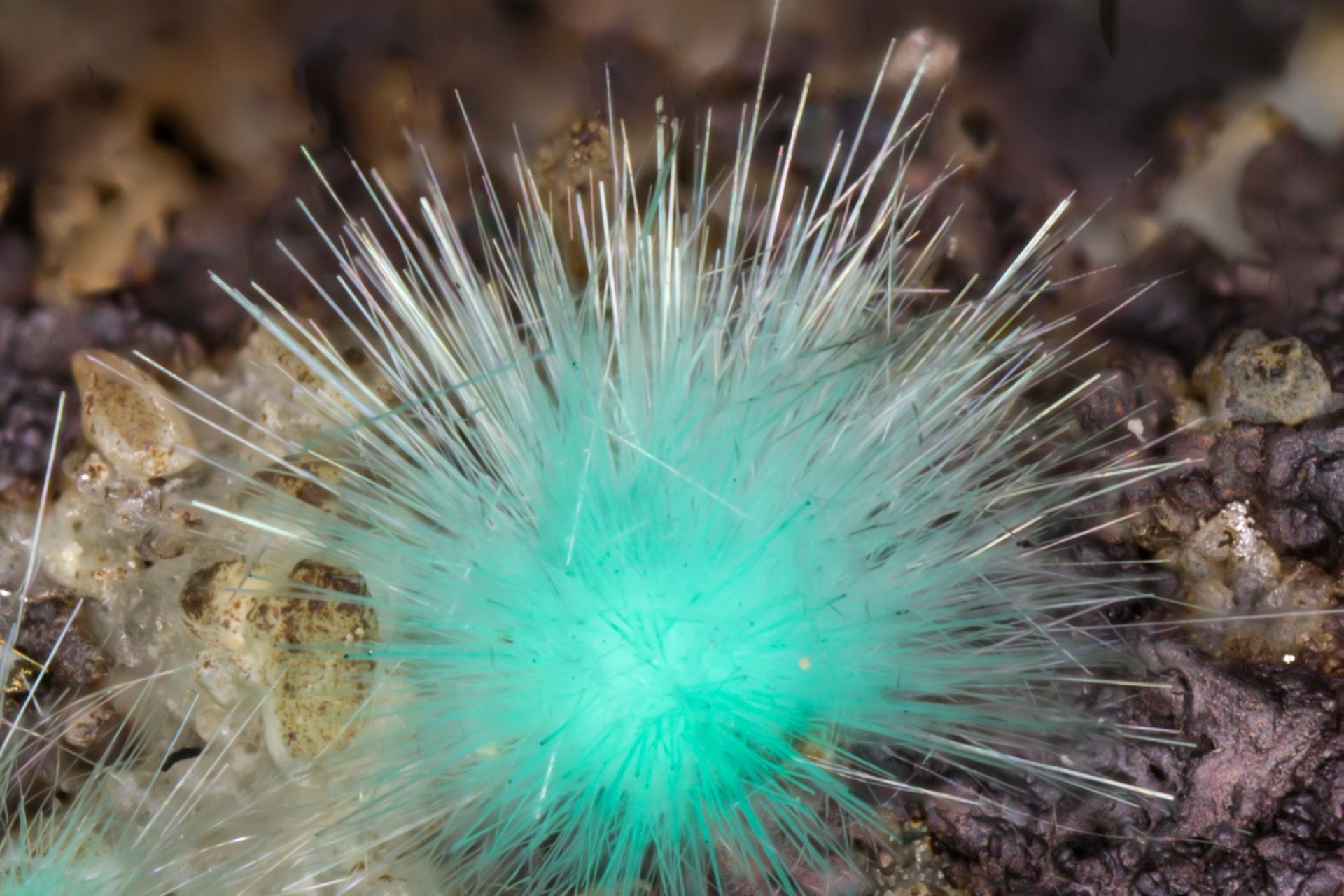
Agardite-(Y) - Greece, Attica, Lavrion District, Kamariza, Hilarion Mine, Level 4 - 1 mm — Photo: Henk Smeets – tomeikminerals.com · CC BY 4.0
Agardite-(Y)
Agardite is a mineral group consisting of agardite-(Y), agardite-(Ce), agardite-(Nd), and agardite-(La). They comprise a group of minerals that are hydrous hydrated arsenates of rare-earth elements (REE) and copper, with the general chemical formula (REE,Ca)Cu6(AsO4)3(OH)6·3H2O. Yttrium, cerium, neodymium, lanthanum, as well as trace to minor amounts of other REEs, are present in their structure. Agardite-(Y) is probably the most often found representative. They form needle-like yellow-green (variably hued) crystals in the hexagonal crystal system.
Intro adapted from Wikipedia (CC BY-SA).
Agardite-(Y) is an IMA-recognized mineral species in the arsenate class, with the chemical formula YCu²⁺₆(AsO₄)₃(OH)₆·3H₂O.
It crystallizes in the hexagonal crystal system (space group P6_3/m). It is a member of the Mixite structural group.
Key properties: specific gravity 3.61–3.72; optically uniaxial.
IMA symbol Agr-Y, IMA status: approved, named in 1968.
Found in the oxidation zone of some copper deposits.
It is found associated with Azurite, malachite, chrysocolla, cuprite, copper, mimetite, quartz.
The mineral was named to honor Jules Agard, geologist, Bureau de Recherches Géologiques et Minières, Orléans, France, and a suffix for dominant yttrium.