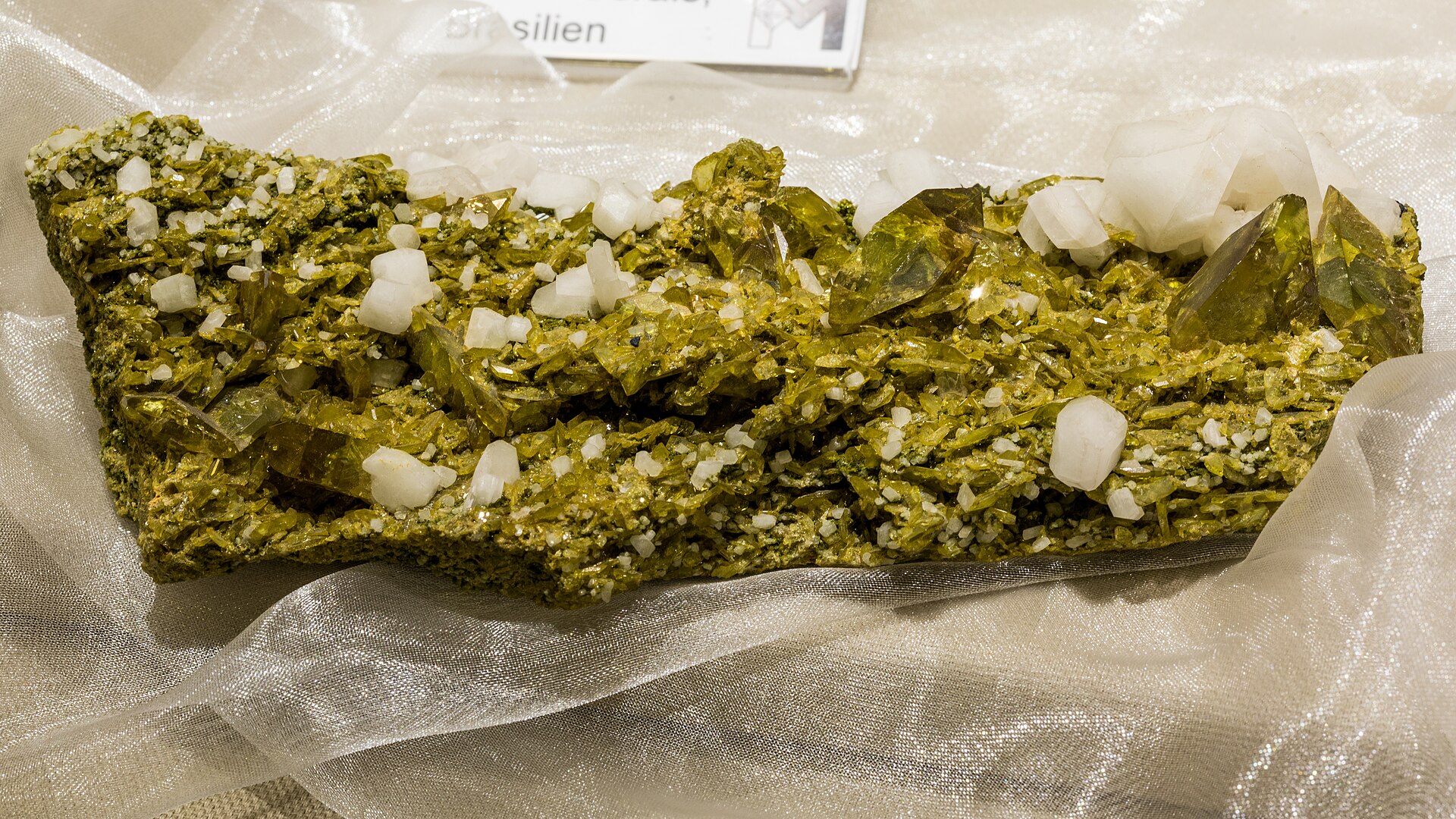
Titanite, Albite, Epidote, Place of discovery: Minas Gerais, Brazil — Photo: Raimond Spekking · CC BY-SA 4.0
Albite
Also known as: Soda feldspar, Cleavelandite.
The sodium end-member of the plagioclase feldspar series — one of the most common rock-forming minerals on Earth.
Intro adapted from Wikipedia (CC BY-SA).
Albite is an IMA-recognized mineral species in the silicate class, with the chemical formula Na(AlSi₃O₈).
It crystallizes in the triclinic crystal system (space group C-1). It is a member of the Feldspar structural group.
Key properties: Mohs hardness 6–6.5; specific gravity 2.6–2.65; typically white or colorless or gray; White streak; Vitreous, typically pearly on cleavages luster; refractive index 1.535; optically biaxial.
IMA symbol Ab, grandfathered status — known before the IMA’s founding, named in 1815.
A major constituent of granites and granite pegmatites, alkalic diorites, basalts, and in hydrothermal and alpine veins. A product of potassium metasomatism and in low-temperature and low-pressure metamorphic facies and in some schists.
It is found associated with Quartz, orthoclase, muscovite, biotite, \hornblende.".
The name comes from the Latin, albus, for white, its characteristic color.
Collections: Everyday Minerals.