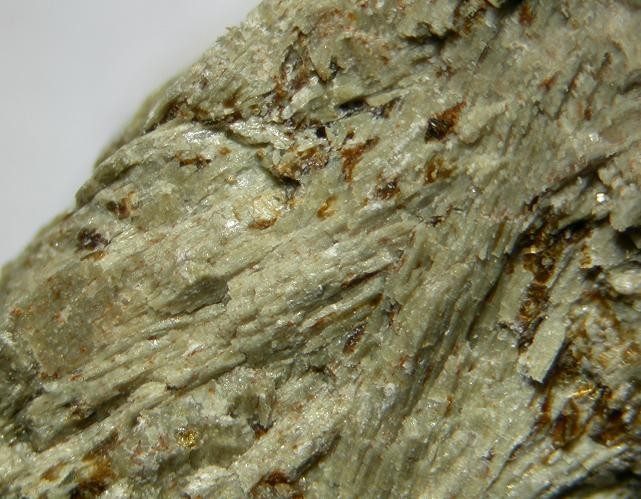
Aliettite Locality: Ingichka Mine (Ingichke Mine), Zirabulak Mts (Zirabulakskie Mts), Samarkand (Samarqand) Viloyati, Uzbekistan Greenish-grey massive Aliettite. Field of view 7 mm. Specimen and photo Leon Hupperichs. — Photo: Leon Hupperichs · CC BY-SA 3.0
Aliettite
Aliettite is a complex phyllosilicate mineral of the smectite group with a formula of (Ca0.2Mg6(Si,Al)8O20(OH)4·4H2O) or [Mg3Si4O10(OH)2](Ca0.5,Na)0.33(Al,Mg,Fe2+)2−3(Si,Al)4O10(OH)2·n(H2O). It is a soft, colorless to pale yellow or green earthy mineral which crystallizes in the monoclinic system as minute tabular to platy crystals. It was first described in 1968 for an occurrence in Monte Chiaro, Albareto, Parma Province, Emilia-Romagna, Italy and named for the Italian mineralogist Andrea Alietti (born 1923). It occurs in serpentinized ophiolites and their residual soil.
Intro adapted from Wikipedia (CC BY-SA).
Aliettite is an IMA-recognized mineral species in the silicate class, with the chemical formula Ca₀.₂Mg₆(Si,Al)₈O₂₀(OH)₄·4H₂O.
It is a member of the Corrensite, Clay structural group.
IMA symbol Ali, IMA status: approved, named in 1968.
An alteration product in serpentinized ophiolites and residual in soils derived therefrom; in altered dolostones.
It is found associated with Talc, chlorite, serpentine, calcite.
The mineral was named to honor Professor Andrea Alietti (1923{), of the University of Modena, Modena, Italy, who first studied the structure of the mineral.