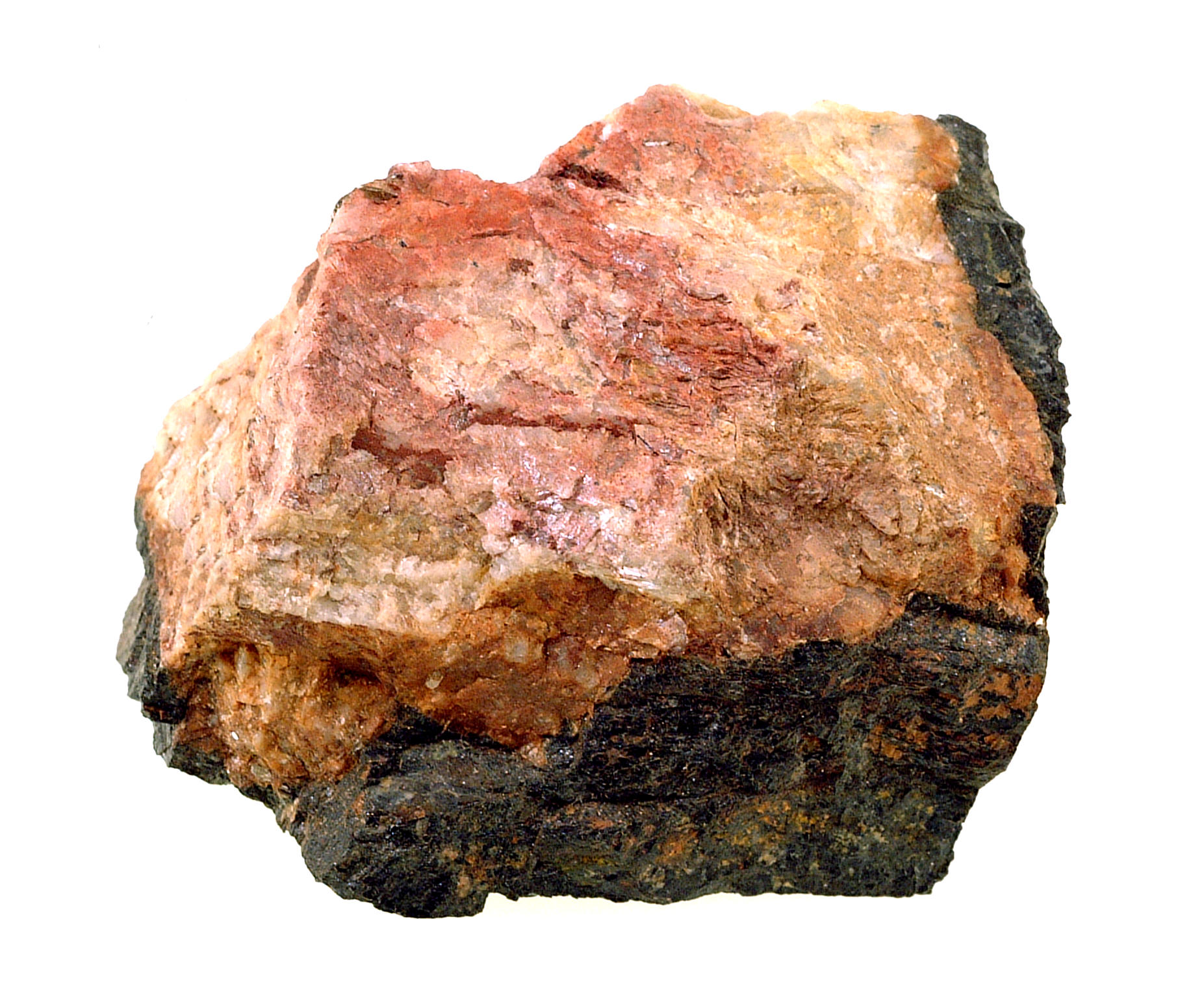
Allanite, called “orthite” in Europe, is one of the most common rare earth minerals. Up to 20% of it's weight may be rare earth elements, making allanite a pote — Photo: Shannon Heinle · CC0
Allanite-(Ce)
Also known as: Allanite, Orthite.
Allanite (also called orthite) is a sorosilicate group of minerals within the broader epidote group that contain a significant amount of rare-earth elements. The mineral occurs mainly in metamorphosed clay-rich sediments and felsic igneous rocks. It has the general formula A2M3Si3O12[OH], where the A sites can contain large cations such as Ca2+, Sr2+, and rare-earth elements, and the M sites admit Al3+, Fe3+, Mn3+, Fe2+, or Mg2+ among others. However, a large amount of additional elements, including Th, U, Be, Zr, P, Ba, Cr and others may be present in the mineral.
Intro adapted from Wikipedia (CC BY-SA).
Allanite-(Ce) is an IMA-recognized mineral species in the silicate class, with the chemical formula CaCe(Al₂Fe²⁺)[Si₂O₇][SiO₄]O(OH).
It crystallizes in the monoclinic crystal system (space group P2_1/m). It is a member of the Epidote, allanite structural group.
Key properties: Mohs hardness 5.5–6; specific gravity 3.5–4.2; typically brown or black or green; Gray streak; Vitreous, resinous to submetallic luster; optically biaxial.
IMA symbol Aln-Ce, IMA status: approved, named in 1812.
An accessory in some granites and granite pegmatites, syenites, more rarely in gabbroic pegmatites. Rarely in schists, gneisses, and some contact metamorphosed limestones; a clastic component of sediments.
It is found associated with Epidote, muscovite, fluorite.
The name refers to Thomas Allan (1777–1833), Scottish mineralogist who discovered the species.
Collections: Collector Favorites.